End of an Empire
Our story between 1918 and 1933 begins, fittingly, with a gamble that briefly looked like victory. The Treaty of Brest-Litovsk in March 1918 knocked Russia out of the war and handed Germany vast territories in the east. For a moment, it seemed Germany might dictate the postwar order! But this success masked a crumbling situation at home: starvation from blockade, war-weariness, and a military stretched to breaking point.
By autumn 1918, defeat in the west loomed, and the imperial system began to unravel faster than anyone in uniform understood. Sailors mutinied in Kiel. Workers and soldiers councils spread across cities, and the monarchy fell in November.
The First german Republic
Founding
Social Democrats were the first to proclaim a republic from the Reichstag while the war in France still raged. They didn’t do it to try and save the war; it was to hold a resemblance of government now that the Kaiser was gone and his oldest son didn’t want the job.
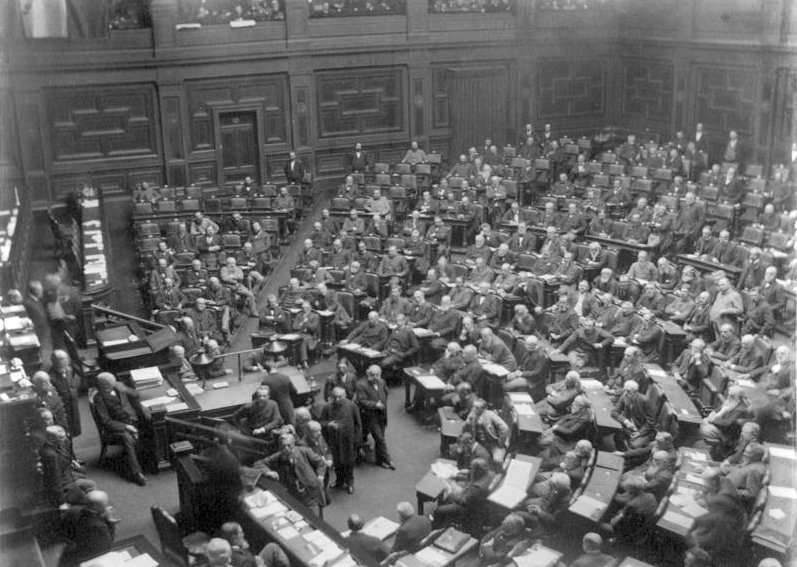
The Social Democratic Party of Germany (SPD) moved quickly to stabilize the situation, proclaiming a republic and trying to channel revolution into parliamentary democracy.
A constitution was passed by the Reichstag in July 1919 and ratified by the Reich President a month later. William Shirer remarks:
On paper it was the most liberal and democratic document of its kind the 20th Century had seen…full of ingenious and admirable devices which seemed to guarantee the working of an almost flawless democracy.
William Shirer, Rise and Fall of the Third Reich. 56
It guaranteed all Germans:
- Equality before the law
- Power to vote at age 20
- Ability to express opinions freely
- Form associations and societies
- Liberty of belief and conscience
But they were not alone in claiming the future. On the left, more radical socialists wanted a Soviet-style system; a dictatorship of the worker. Conservatives and nationalists wanted a conservative dictatorship. These formed into a group known as Spartacists, favoring a massive proletariat revolt led by Rosa Luxembourg and Karl Liebknecht.
The Left exploded in the Spartacist Uprising of January 1919. Led by Bolshevik radicals, they sought to push Germany toward a full Communist revolution. It kicked off what became known as ‘Bloody Week’ by Berliners, there was street fighting between Spartacist and government-backed garrison troops. It did not go well, the government was forced to flee the city early on.
Machine-gun fire rattles while I write!! The Spartacus people have occupied all of the newspaper offices. Your father has just told me that a regiment of the Guards has gone over to their side.
Betty Scholem
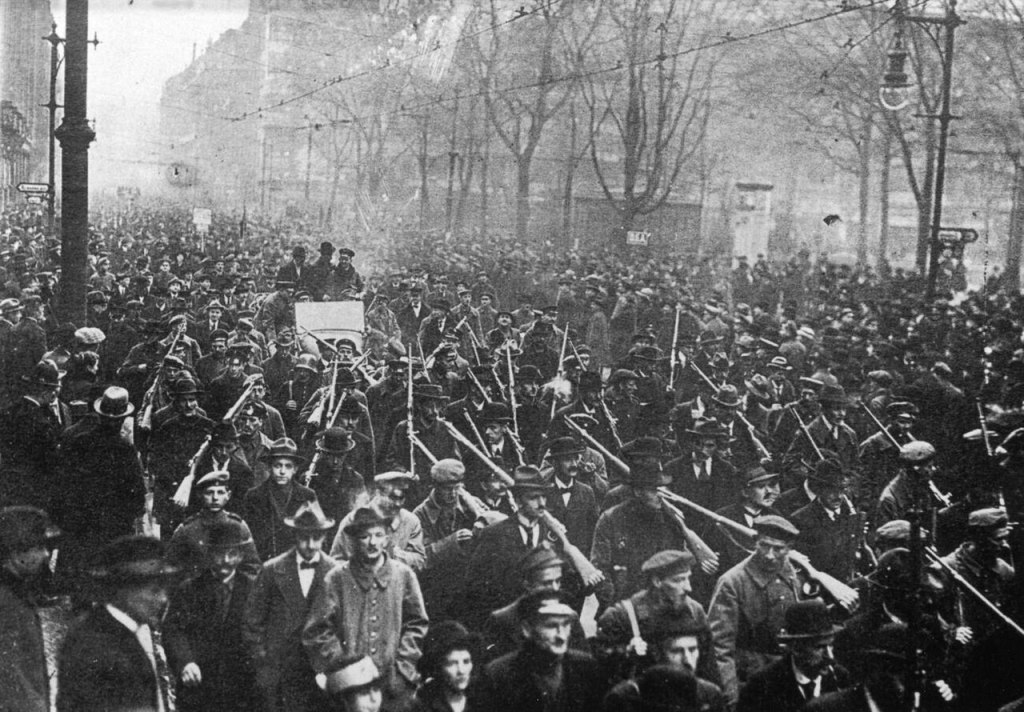
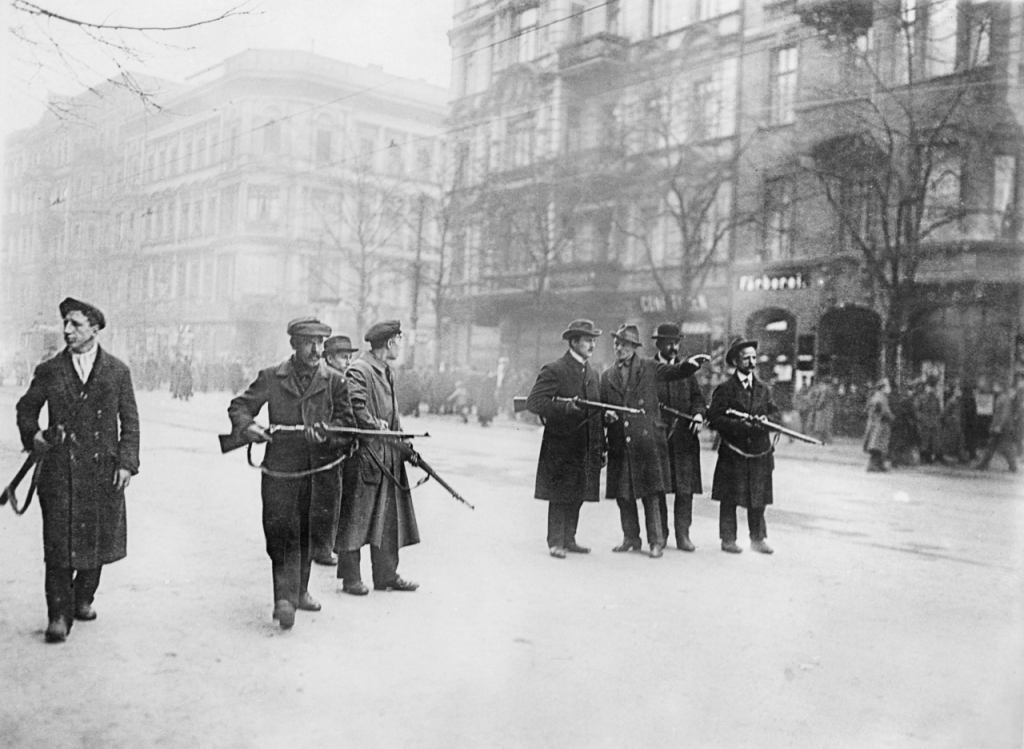
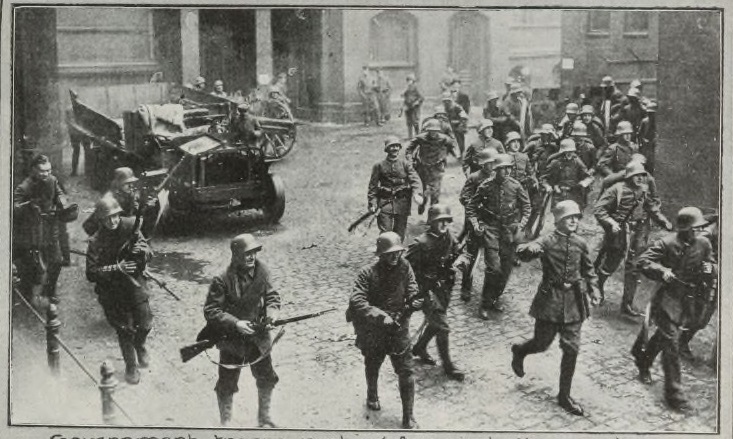
Industrial workers and unionists were armed and given instructions to seize specific [objectives]. Protesters occupied…government buildings, police stations; important roads and intersections were barricaded.
The German Revolution, 73
Fearing general anarchy, the government used right-wing paramilitary Freikorps units to crush it. The uprising failed. Its leaders were murdered without trial. From this point on, distrust between moderates and communists hardened into something closer to hatred; an irony that would later help their mutual enemies.
Cost of Defeat: The Versailles Treaty – 1919
The Deadline:
The Armistice was renewed several times while negotiations continued in France. On June 24, 1919 the German delegation was given an ultimatum to sign or the Allies would “take such steps necessary to enforce their terms.” (Shirer 59)
In layman’s terms, the Allies were prepared to invade Germany to enforce the treaty if the deadline lapsed without a signing.
The Versailles Diktat
The Treaty of Versailles. Many citizens never forgave the founders for signing it. It imposed harsh territorial losses, military restrictions, and heavy reparations. Farmers had to surrender livestock and foodstuffs.
On the far left, the Communist Party of Germany (KPD) emerged as a disciplined and increasingly influential force. Inspired by Moscow and hostile to the SPD, the KPD rejected parliamentary democracy as a bourgeois (French term, meaning middle class) sham. They organized uprisings, strikes, and agitation, especially in industrial regions. Meanwhile, the center struggled to govern, constantly juggling coalitions.
Germany in the early 1920s resembled a political street fight more than a stable state, with armed factions and ideological militancy becoming normal.
Instability soon took a more direct form. In 1920, right-wing forces attempted to overthrow the republic in the Kapp Putsch. Government leaders fled Berlin leaving it to be occupied by the Freikorps (below left). The capital soon fell under martial law with soldiers setting up checkpoints and patrolling the streets (center). For a few tense days it seemed the republic might collapse. The army refused to defend it (hardly reassuring in hindsight!) but the coup was soon defeated when workers launched a massive general strike (below right) which paralyzed the country.
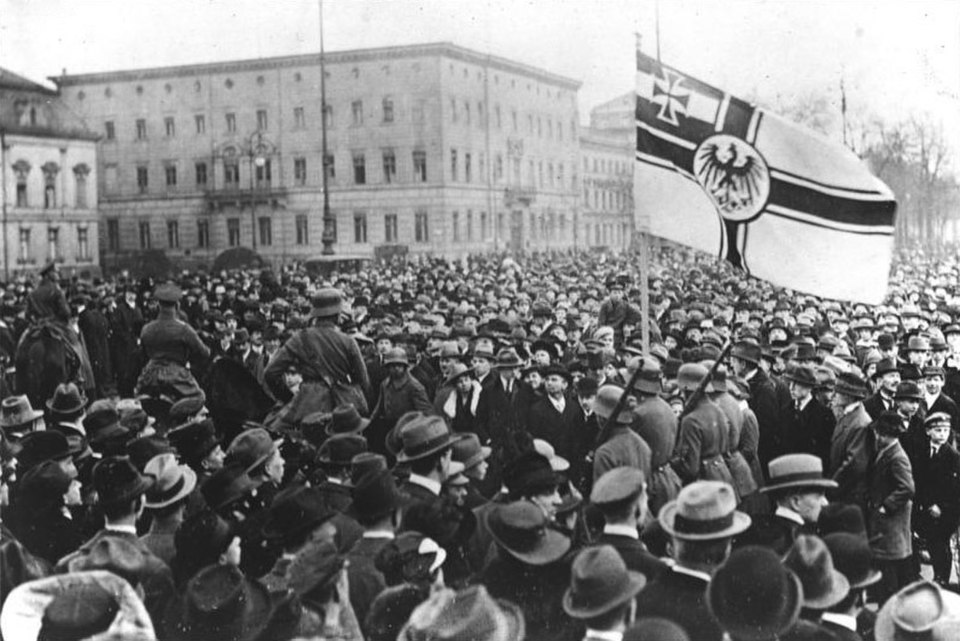
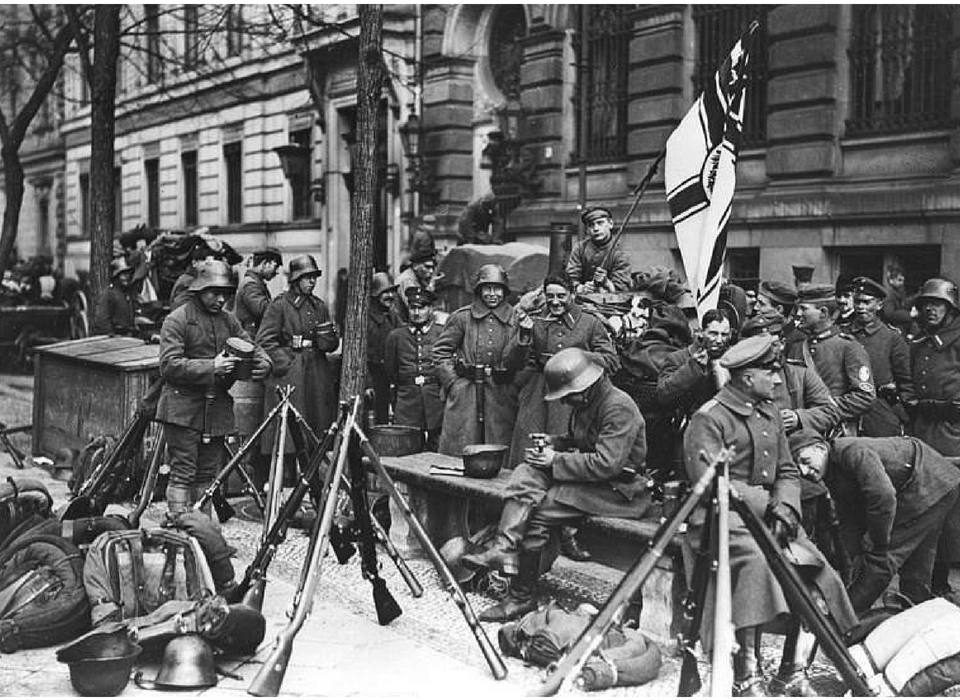
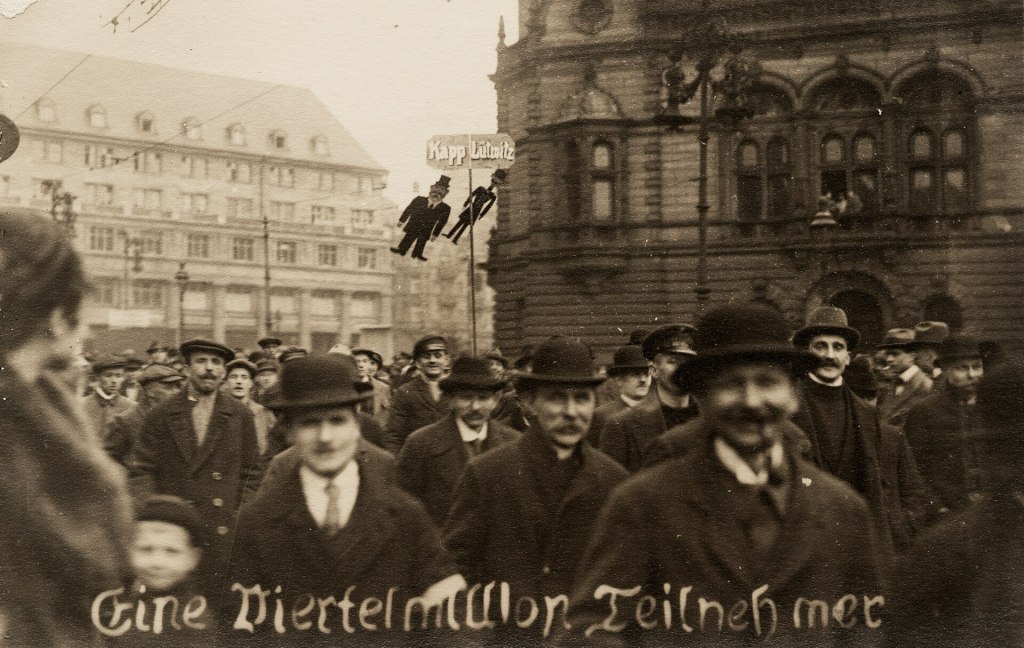
The coup failed, but the message was clear: the state was fragile, and its survival depended as much on reluctant defenders as on committed democrats.
Runaway Inflation 1923
Then came the crisis of 1923. Hyperinflation wiped out savings, reduced wages to paper scraps, and turned daily life into a frantic scramble to spend money before it lost value by the hour (literally!). People went about their daily lives as normal as possible under the farcical conditions.
“A pound of potatoes which yesterday had cost fifty thousand marks now cost a hundred thousand. The salary of sixty-five thousand marks brought home the previous Friday was no longer sufficient to buy a packet of cigarettes on Tuesday.”
Sebastian Haffner. Defying Hitler.
Monetary notes continued to be printed with higher and higher values leaving the smaller ones worthless. (Shown Below)
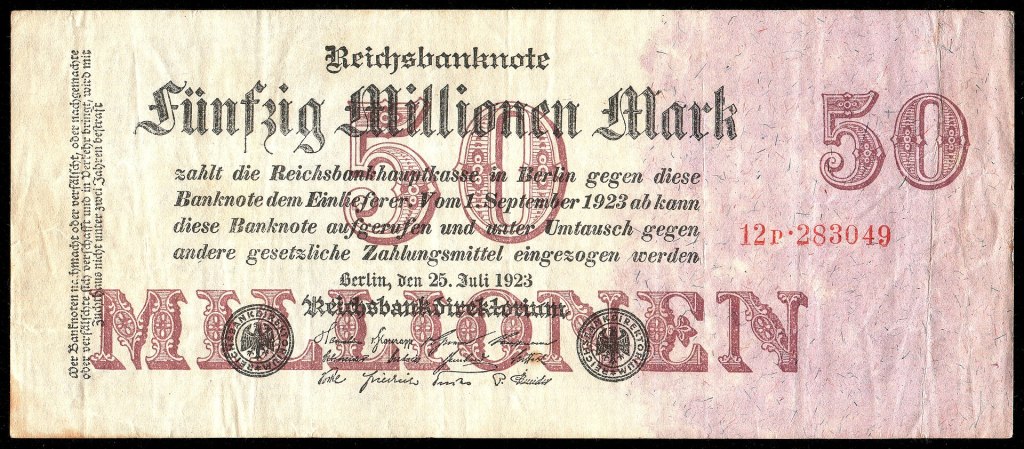
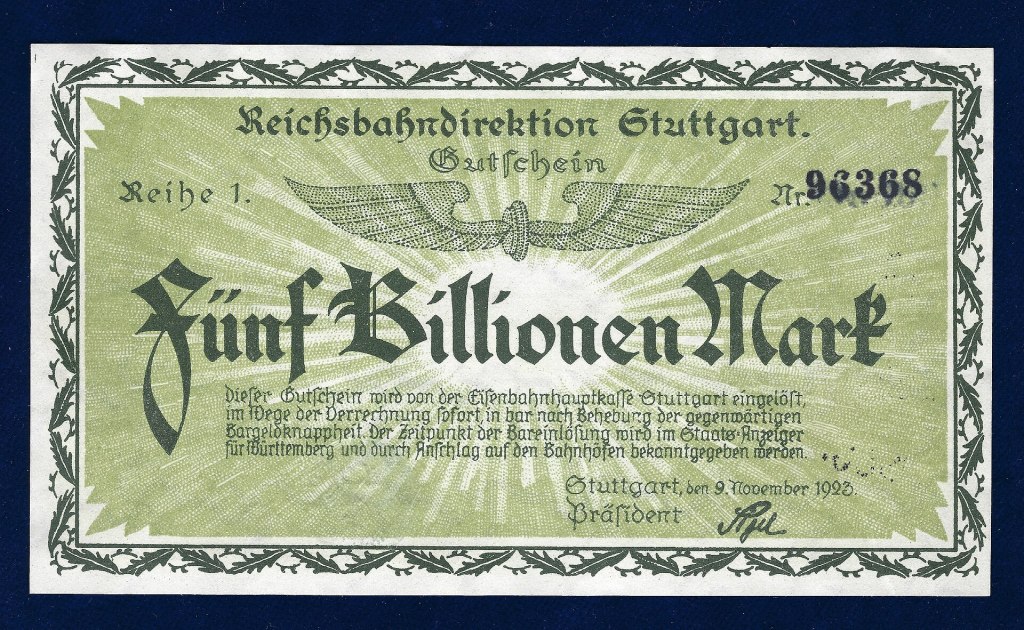
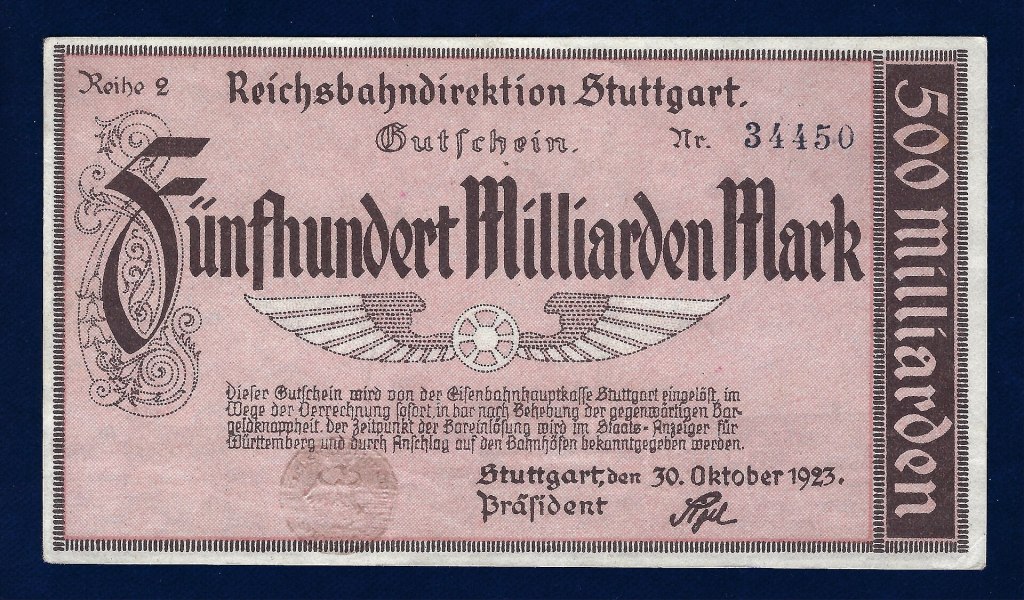
“There were beggars everywhere and many reports of suicides in the papers. The poster columns were full of police ‘Wanted’ notices for burglars. Robbery and burglary occurred on a grand scale.”
Sebastian Haffner. Defying Hitler
“Middle-class savings were wiped out, and the working class faced rising unemployment and food shortages. The result was a profound sense of betrayal and anger.”
Isabella C Hayes, Hitler’s Path to Power
In this chaos, extremist movements flourished. Among them was the Nazi Party (NSDAP). Led by Adolf Hitler, they attempted to stage a coup in Munich to take control of the city. After they took the city, they planned to march on Berlin. It failed. Hitler went to prison, but the episode gave him national attention.
The mid-1920s offered a brief, almost deceptive calm. Economic stabilization under the Dawes Plan gave the republic breathing room. The SPD remained a mighty force in Parliament, while moderate parties tried to anchor democracy. Yet beneath the surface, resentment lingered.
Some never fully accepted the republic as legitimate. Monarchists saw the new government as a usurper against the former imperial throne. Nationalist movements saw the country besieged by foreign powers. These factions worked against each other more frequently than they did together leaving the people to deal with their own affairs.
Political Stalemates 1929-1931
That crisis arrived with the Great Depression after 1929. Unemployment soared, businesses collapsed, and faith in democratic institutions evaporated. The KPD gained support among the desperate working class, while the NSDAP surged by appealing to nationalism, fear, and promises of renewal. Parliamentary government broke down into presidential decrees, with leaders ruling through emergency powers rather than stable majorities.
The hearts and minds now became the primary battleground between the two opposing factions. Many theorists and writers penned writings envisioning a utopian future society. For many on the left that meant fair wages, free-thinking, and
Conservative elites increasingly pinned their hopes on Paul von Hindenburg as a kind of living anchor in a drifting political system. To them, he was more than a politician; he was the hero of Tannenberg, a symbol of order, hierarchy, and a Germany that still made sense. When he became president in 1925, many on the right imagined he would steady the republic without quite embracing it, quietly restraining parliamentary chaos and keeping radicalism, especially from the KPD, at bay. Even some moderates tolerated this arrangement, hoping his authority might lend dignity to a system that often looked like a brawl.
Hindenburg proved less a stabilizer than a caretaker presiding over decline. As crises deepened after 1929, he relied more on presidential decrees and a revolving door of chancellors, which hollowed out parliamentary government rather than saving it. He never became the unifying national figure the way conservatives anticipated. Still, his personal prestige endured. He remained a revered war hero and a familiar face of authority in a country hungry for it.
Democracy Dies 1932-1933
By now the political system had effectively disintegrated. The Reichstag ceased to function as a governing assembly. Nazi agitators and Communist reactionaries staged constant walkouts and refused cooperation with the other. Talk around the cafes and beer gardens was Germany would soon slip into civil war between the Nationalists and Nazis against the Communists. Everyone agreed there would be an eventual dictatorship; what was unclear is which side would take over.
The Nazis became the largest political party by late 1932. But it still did not hold an majority. It was backroom deals brought Hitler into power as chancellor in January 1933.
On February 27, 1933, an arsonist set fire to the Reichstag resulting in its ruin. The man was arrested and interviewed. Hitler used the arsonists’ ties to the communists as evidence of a grand conspiracy to topple the government. It was alleged:
“Government buildings, museums, mansions and essential plants were to be burned down… Women and children were to be sent in front of terrorist groups… The burning of the Reichstag was to be the signal for a bloody insurrection and civil war…”
William Shirer. Rise and Fall of the Third Reich
The Reichstag Fire Decree
The day after the fire, on February 28, Reich President Paul von Hindenburg signed the Decree of the Reich President for the Protection of People and State, acting under Article 48 of the Weimar Constitution.
It SUSPENDED basic civil protections involving:
- Freedom of speech and the press
- Freedom of assembly and association
- Privacy of mail and telephone communications
- Protection against arbitrary searches and confiscation
- Protection against detention without charge
“We were prepared. We knew the intentions of our enemies. I had put together a small squad from the most daring of the daring! We lay in wait night after night…then the beacon in Berlin. Finally the relief of the order:
Go to it!”
Richard J Evans. The Coming of the Third Reich
Prominent Communist Party members and many Social Democrats were arrested the night of or morning after the fire. Other leftist writers, journalists, and other critics of the Nazi Party were detained or placed under “protective custody” by police or Nazi Brownshirts.
“Some four thousand Communist leaders and many Social Dem leaders were arrested including members of Parliament. Truckloads of SA men roared through the streets, breaking into homes, carting victims off to barracks to be beaten.”
Charles River Editors. The Burning of the Reichstag
The Enabling Act
When the Reichstag reconvened on March 23, they met at the Kroll Opera House. Brownshirt and black-clad SS formations surrounded the building, occupied the gallery, and blocked the doors.
The Nazis used this opportunity to propose a vote on the Law to Remedy the Distress of People and Reich authorized Hitler’s cabinet to:
- Enact laws without the Reichstag
- Enact laws without regard to the constitution
- Publish legislation without the president’s signature
- Control the budget
- Approve treaties without parliamentary consent
The law was known as the Enabling Act. It was passed under duress by a vote of 444:94. Within months the other political parties voted themselves out of existence leaving the Nazis holding absolute power in Germany.
What began in 1918 as a desperate attempt to build a republic out of a defeated empire ended, fifteen turbulent years later, in its legal dismantling; quietly, efficiently, and with enough votes to make it look almost respectable.
The Third Reich
The Anti-Weimar
Nazi politics after 1933 didn’t replace the Weimar system with a clean, orderly machine. It dismantled it and then built something deliberately opaque in its place. The Enabling Act of 1933 allowed Adolf Hitler and his cabinet to legislate without the Reichstag. In one legal stroke, the checks and balances of parliamentary democracy (debates, coalitions and opposition) were neutralized. What followed wasn’t just a dictatorship; it was a system designed to concentrate power upward while blurring responsibility downward.
On paper, Germany still had ministries, laws, and procedures. In practice, these institutions increasingly existed to ratify decisions already made elsewhere. That elsewhere was the Fuhrerprinzip, which elevated Hitler’s will above all formal authority. Instead of rule by law, Nazi governance drifted toward rule by interpretation: officials tried to anticipate what Hitler wanted and act accordingly. The system rewarded initiative, not accountability. If you guessed right, you advanced. If you guess wrong, bad things could happen to you. It was less a bureaucracy than a competitive guessing game with lethal stakes.
The Fuhrerprinzip, or principle of leadership, laid down that at all levels of the organization authority was concentrated in a single individual.
Noakes and Pridham. Nazism 1919-1945, Volume 2: State, Economy and Society 1933-1939, 198
Historians have often described this structure as “organized chaos”. The idea captures how overlapping authorities were a feature. Ministries competed with party offices, regional leaders with central agencies, and state officials with paramilitary organizations. Clear lines of responsibility, something most efficient governments rely on, were intentionally avoided.
Legalese
The legal framework of the state was hollowed out piece by piece. Power drifted to regional party bosses called Gauleiters. These men were responsible for ensuring each district, called Gau, functioned in line with the will of the Nazi Party. Yet orders coming from above could be vague. Thus, personal initiative was encouraged and fueled competition between Gaue (plural). With little oversight, the districts became their personal fiefdoms to rule as they saw fit. Corruption was common.
The Reichstag became ceremonial, elections turned into plebiscites, and political parties outside the Nazi Party (NSDAP) were banned. After the Reichstag Fire, parliament met at the Kroll Opera House several hundred meters away. Speeches aggrandizing the Party and denouncing foreign governments replaced debates and procedure. Everything became scripted.
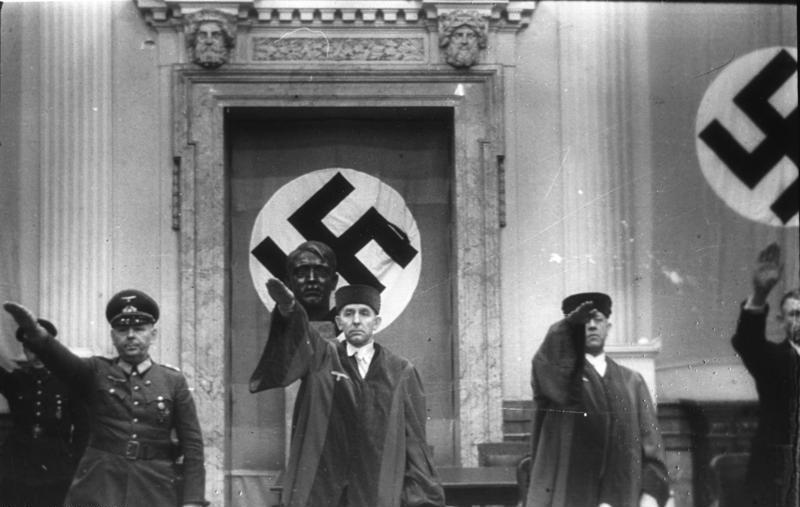
Courts and judges were sidelined or brought into line. The basic Western legal principle of no crime, no punishment without a pre-existing law, ceased to be. German courts were pushed to decide cases according to new principles. Chiefly, align the outcome with the will of the Party. The rules could be rewritten later.
Ministers Without Portfolio
One of the most striking examples was the rise of parallel institutions that duplicated or undermined traditional departments. The SS, under Heinrich Himmler, built its own empire of policing, intelligence, and racial policy. It could bypass the Interior Ministry entirely. Meanwhile, party offices issued directives that clashed with law, and no single authority consistently arbitrated disputes. Instead, conflict itself became a driver of radicalization.
Even economics reflected this fragmented structure. Competing agencies, like those run by Hermann Goering in the Four-Year Plan, overlapped with traditional ministries. Industrial policy, rearmament, and resource allocation were handled through a maze of offices, each pushing its own priorities while trying to align with Hitler’s broader vision. Efficiency was less important than momentum and ideological conformity.
Crucially, many of the regime’s most powerful figures held positions without clear administrative portfolios. They were “leaders” rather than ministers in the traditional sense. Their authority came from proximity to Hitler and their role within the party, not from defined legal responsibilities. This blurred the distinction between state and party until the two became nearly indistinguishable.
The result was a system where initiative often meant escalation. Officials competed to prove loyalty by pushing policies further, especially in areas like racial legislation, repression, and expansionism. Without firm institutional limits, the question was rarely “is this legal?” but “did we go far enough?” In that sense, the absence of checks and balances didn’t just enable radical policy but encouraged it.
Smoke and Mirrors
At the same time, the regime maintained a facade of order and legitimacy. Laws were still passed, courts still operated, and bureaucratic paperwork continued as if nothing unusual was happening. This dual reality of chaotic power structures beneath a veneer of legality allowed Nazi governance to function while masking its instability. It looked like a state, even as it behaved like a shifting network of rival fiefdoms.
By the late 1930s, Hitler stood above the chaos, intervening selectively while allowing subordinates to compete below him. It was a regime that thrived not despite its disorder, but because of it. It was a structure where confusion ensured loyalty, rivalry drove radicalism, and the absence of clear limits made almost anything possible.
Works Credited:
- Shirer, William. Rise and Fall of the Third Reich. Simon and Schuster, NY. 1960
- Noakes & Pridham. Nazism 1919-1945 Vol.3: Foreign Policy, War, and Racial Extermination. University Exeter Press. 1997.
- History Hourly. The German Revolution: From Beginning to End. e-book. 2020
- Charles River Editors. The Burning of the Reichstag.
- Evans, Richard J. The Coming of the Third Reich.
- Hayes, Isabella. Hitler’s Path to Power
- Haffner, Sebastian. Defying Hitler
Image Credits
- Reichstag in Session:: Wikimedia Commons. Unedited. Bundesarchiv Bild 147-0978, Reichstag, Plenarsitzungssaal
- Spartacists 1: Wikimedia Commons. Public Domain. Unedited
- Spartacists 2: Wikimedia Commons. Public Domain. Unedited
- Spartacists 3: Wikimedia Commons. Public Domain. Unedited
- Kapp 1: Wikimedia Commons. Public Domain. Unedited
- Kapp 2: Wikimedia Commons. Public Domain. Unedited
- Kapp 3: Wikimedia Commons. Public Domain. Unedited
- 50 Million Mark:: Wikimedia Commons. Public Domain. Unedited
- 500 Million Mark:: Wikimedia Commons. Public Domain. Unedited.
- 5 Billion Mark:: Wikimedia Commons. Public Domain. Unedited.
- People’s Court:: Wikimedia Commons. Unedited. Bundesarchiv Bild 151-39-23
Ordinary Lives, Extraordinary Times.
(c) Jay Daniels. All Rights Reserved.

