“Funny the Nazis got so worked up about the Reichstag. Until then they had contemptuously called it a ‘hot air factory’. Now it was burned down it was suddenly the holiest of holies.”
Sebastian Haffner, Defying Hitler.
The Motive
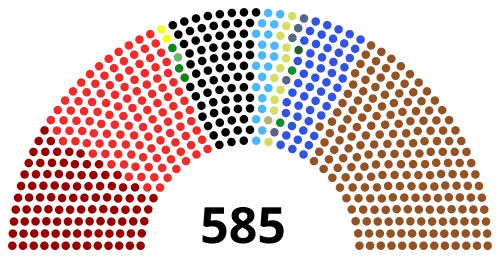
German Parliament, Nov. 1932
Communists: 100 seats
Social Dems: 121 seats
Center Party: 70 seats
Nazi Party: 196 seats
Other: 98 seats
When Adolf Hitler was appointed Reich Chancellor in January 1933, he led the largest political party in Germany.
Now it will be easy to carry on the fight for we can call on all the resources of the State. Radio and press are at our disposal. We shall stage a masterpiece of propaganda. And this time, naturally, there is no lack on money.
Shirer, William. Rise and Fall of the Third Reich, 189.
But he did not yet control parliament. Social Democrats, Centrists, and Communists challenged their policies; sessions degraded into shouting matches, deadlocks, and mass walk-outs. It ceased to be a legislating body and became a ideological battlefield instead.
This was a tactic to prevent the Reichstag from doing anything productive.
President Hindenburg dissolved parliament and called for new elections set for March 5. Article 48 of the German Constitution gave him that right when the government ceased to function.
The Crime
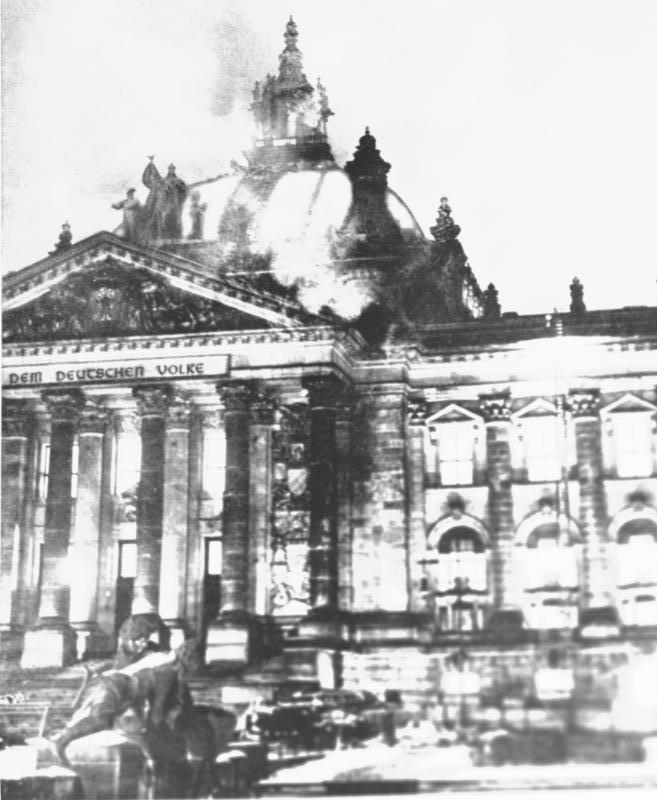
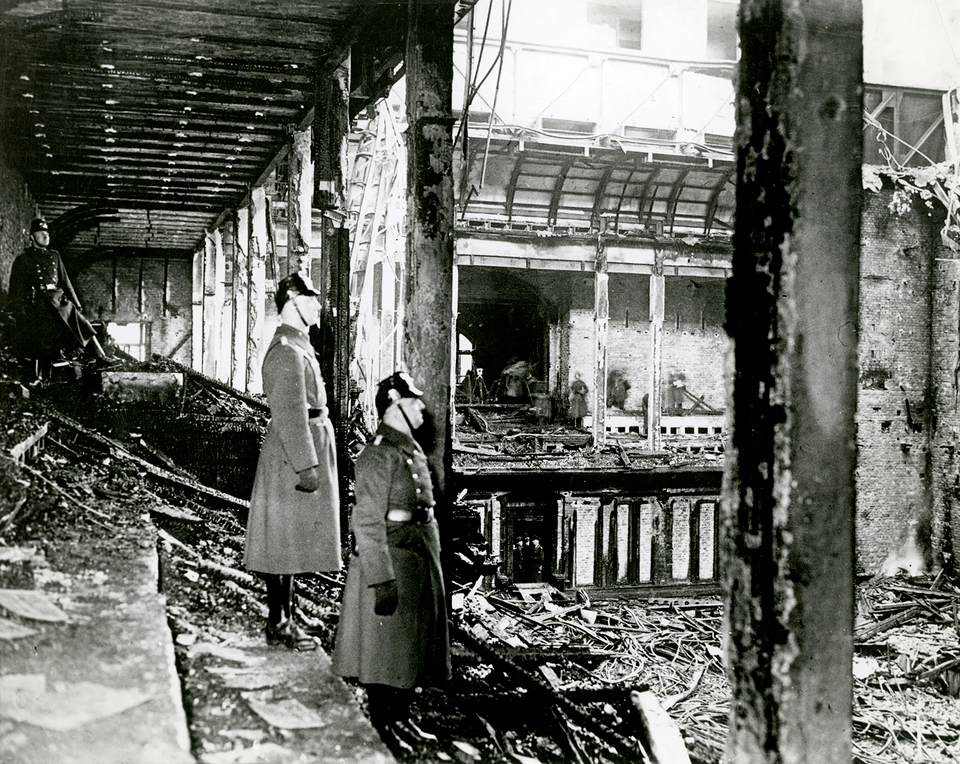
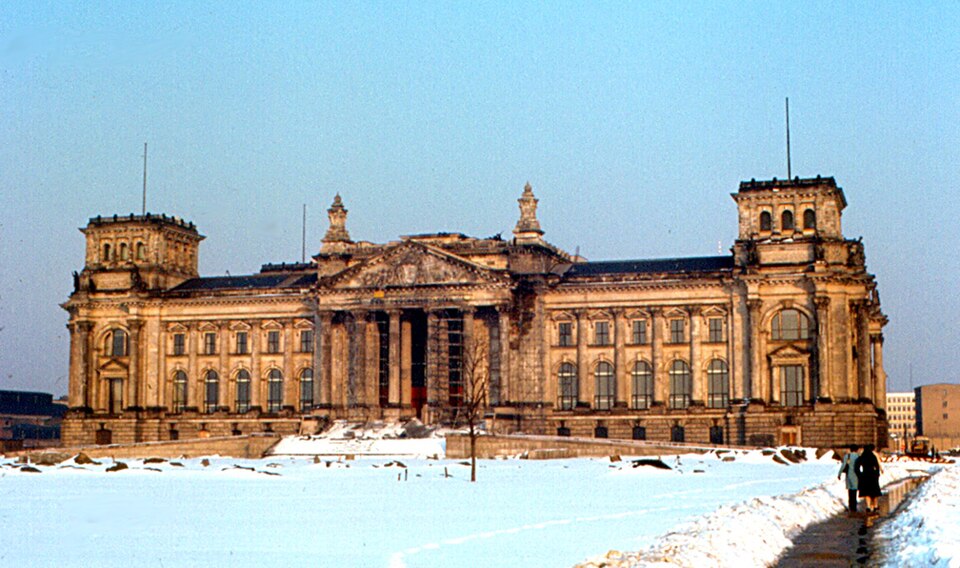
On the night of February 27, 1933, German parliament burned to the ground. The first alarm came around 9:00 p.m. By the time police and firefighters arrived the building was already engulfed in flames and eventually destroy its gilded cupola and main chamber causing roughly $1 million in damage.
We noticed a red glow through the window and heard sounds of shouting in the street. One of the servants came hurrying to me and said The Reichstag is on fire!…from the window we could see the dome of the Reichstag…every now any again a burst of flame and a swirl of smoke blurred the outline.
Shirer, William. Rise and Fall of the Third Reich. 192.
Police arrested a young unemployed communist from the Netherlands on the scene. Twenty-four year old Marinus van der Lubbe was apprehended “naked from the waist upwards. Smeared with dirt and sweating,” according to police reports. While in custody, he claimed to have set the fire to protest the high unemployment and acted alone.
The Official Story
Marinus van der Lubbe, a known arsonist, broke into the Reichstag. Once inside the dark and unfamiliar building, he found his way into the main assembly chamber and used his own shirt to set a fire. Two minutes following his entry, the entire building was engulfed in flames.
Police apprehended him at the scene at took him into custody where he quickly confessed his actions.
The fire was to signal the beginning of a communist revolution against the government. Families of police and other civilians would be used for human shields in their attempt to seize control of Germany and turn it into a Soviet republic.
In the resulting raids on Communist homes and offices, Nazi officials claimed to find written instructions that were to be delivered to the Red Front fighters.
Government buildings and…essential plants were to be burned down. Women and children were to be [used as human shields]. The Fire was to be the signal for a civil war.
Shirer, William. Rise and Fall of the Third Reich. 195
The Plausible Story
We will never know what really happened that night.
What we do know, is van der Lubbe had already unsuccessfully attempted to set fire to several government buildings. He was overheard by numerous credible witnesses at a bar boasting how he planned to burn down the Reichstag building next.
Coincidentally, the Nazis themselves may have been planning on doing this deed themselves. Hermann Goering, head Party boss in Prussia at the time, planned many operations and made a list of the Opposition to be arrested immediately following an emergency decree.
A squad of Brownshirts could have ran from the Reich President’s Palace down an underground tunnel which connected it to the Reichstag. The quietly entered the building, doused the main chamber in gasoline and other chemicals before quickly departing to wait for their patsy to finish the job for them.
An experienced firefighter gave testimony later, during the trial of Marinus van der Lubbe. In his expert opinion, accelerants were used:
The trail ran from one door to the other. A few stretches of carpet along the trail were completely burned out. [It’s] believed it had been gasoline. [Another] testified to seeing a fire on a runner that led from the lobby to the plenary chamber and described another fire in a line against the wall which he first mistook for floor lighting.
Charles River Editors. Burning of the Reichstag, 55
Van der Lubbe swore had matches and only his own shirt as kindling (hence, being arrested “naked from the waist up”). He boasted with pride he acted alone.
As we have discussed above, this is not supported by the evidence. But we cannot entirely take van der Lubbe, a career criminal, at his word and we certainly cannot take the Nazis at theirs.
Emergency Powers
Under the advisement of the chancellor, President Hindenburg declared a national emergency and signed the Reichstag Fire Decree on February 28. It stripped away civil liberties at the stroke of a pen:
Restrictions on personal liberty, the right of free expression of opinion, including freedom of the press; on the rights of assembly and association; and violations of the privacy of postal, telegraphic, and telephonic communications, and warrants for house searchers, orders for confiscations as well as the restrictions on property, are also permissible beyond legal limits otherwise prescribed.
Shirer, William. Rise and Fall of the Third Reich, 194.
The United States has a right called habeus corpus; that is the idea that the State must justify holding you under arrest and your ability challenge your arrest in a legal court in front of a judge. Weimar Germany had the same concept guaranteeing an individual’s personal liberty against wrongful incarceration. That was suspended indefinitely after the fire. This means if you are arrested by Nazi authorities, you had to hope they find a reason to let you go because with the privilege to an attorney, you have no way to challenge the new system.
Its shadow stretched deep into daily life.
None of them saw anything out of the ordinary from now one one’s telephone would be tapped, one’s letters opened, and one’s desk might be broken into.
Haffner, Sebastian. Defying Hitler, 121
Anti-Red Terror
Nazi Brownshirts were deputized by the police. Truckloads of storm troopers roared through the streets all over Germany breaking into homes, rounding up victims, and carting them off to makeshift jails where they were tortured and beaten.
We were prepared. We knew the intentions of our enemies. I had put together a small squad from the most daring or the daring! We lay in wait night after night…then the beacon in Berlin. Finally the relief of the order: Go to it!
Evans, Richard. The Coming of the Third Reich. 334
The first wave of arrests came mere hours after the fire. Each city saw a wave of raids against homes and businesses. Old scores could now be settled under the guise of national security. Tens of thousands of Nazi opponents were arrested or placed under ‘protective custody’.
Police, both official or deputized Nazis conducted mass surveillance, arbitrary arrests, and raids against pro-Communist unions, printing offices, and personal homes. Newspapers, meeting halls, bars, political organizations. Hundreds, particularly those on the Left, were shut down or banned with its staff under arrest.
Within hours, the police arrest sheets at Alexanderplatz prison read like a who’s who of writers, lawyers, and politicians [who’d made enemies of the Nazis]…Everyone knows everyone else and every time someone new is dragged in by the police there are greetings all around.
Wachsmann, Nikolaus. KL: A History of the Nazi Concentration Camps. 29
Left-wing parties were forbidden from any further election campaigning in Germany. Political rallies and speeches were canceled. Left-wing newspapers were shut down. Campaign posters were painted over.
As always, rumors swirled on the lips of Germans everywhere. Two English correspondents enroute to Berlin stopped in a small town for a bite of lunch when they heard the news. When other guests learned of their destination they launched into retelling the gossip they’d heard out-and-about, that Berlin was under martial-law. The communists had torched the place but were now all in custody. When they finally arrived in Berlin that evening there was nothing of note occurring in the city. [Boyd 111].
Lady Rumbold, wife of the British Ambassador, wrote afterwards:
Summoning popular reaction to the catastrophe she reported…although it was unlikely anyone would get to the bottom of it most people, even Hitler’s supporters, assumed the fire had been started by the Nazis themselves to discredit the communists before the elections.
Boyd, Julia. Travellers in the Third Reich. 109
Final Thoughts
The issue wasn’t people whole heartedly believed the ‘official’ story but it was plausible enough to temporarily suspend disbelief against our better judgement. We use it in court each day.
The KPD launched several inglorious and unsuccessful revolts in the fifteen years since the birth of the republic and had grown strong in recent years. At the time of the fire it was the largest minority party in parliament and generous donations from powerful figures. They used guns in street brawls and likely had a small arsenal of rifles. Though I have no sources to prove this but each paramilitary wing probably had their own weapon stockpiles.
For the general pubic, there was no surprise if the KDP set the fire:
A Communist attack is what we expected. They were determined people with fierce expressions. They raised fists in salute, had weapons. They boasted continually about the strength of their organization and probably learned how to do ‘these things’ in Russia.
Haffner, Sebastian. Defying Hitler, 120
Communist propaganda was too successful for their own good. It portrayed itself as an ultra-organized, armed revolutionary movement which already toppled one country. As the graph at the top of the page shows while the KPD was large, it was by no means a competing majority to the Nazi Party. But they wanted a revolution. Was it so far fetched burning down the government would ignite a civil war?
The mind didn’t see the timing of the arrests happened too quickly after the fire? Everyone had lists. But the government, now firmly in the hands of the Nazis, forbade any political opposition from advertising and campaigning right before a major election. The people were so afraid of the Communists
Most non-Nazi conservatives on the ballots were already waiting until after the election to switch parties at the behest of the National Socialists.
Image Credits:
- Reichstag Diagram:: wikimedia. Public Domain. Unedited.
- Reichstagsbrand:: Unknown Author. CC BY-SA 4.0 https://creativecommons.org/licenses/by-sa/3.0/de/deed.en. Unedited.
- Firemen in the Reichstag:: https://creativecommons.org/licenses/by-sa/4.0/deed.en, ASLhistoryGHKU. CC BY-SA 4.0. Unedited.
- Reichstag 1970:: Author Link Source
“Ordinary Lives, Extraordinary Times”
(c) Jay Daniels. All rights reserved.
 Ordinary Lives, Extraordinary Times