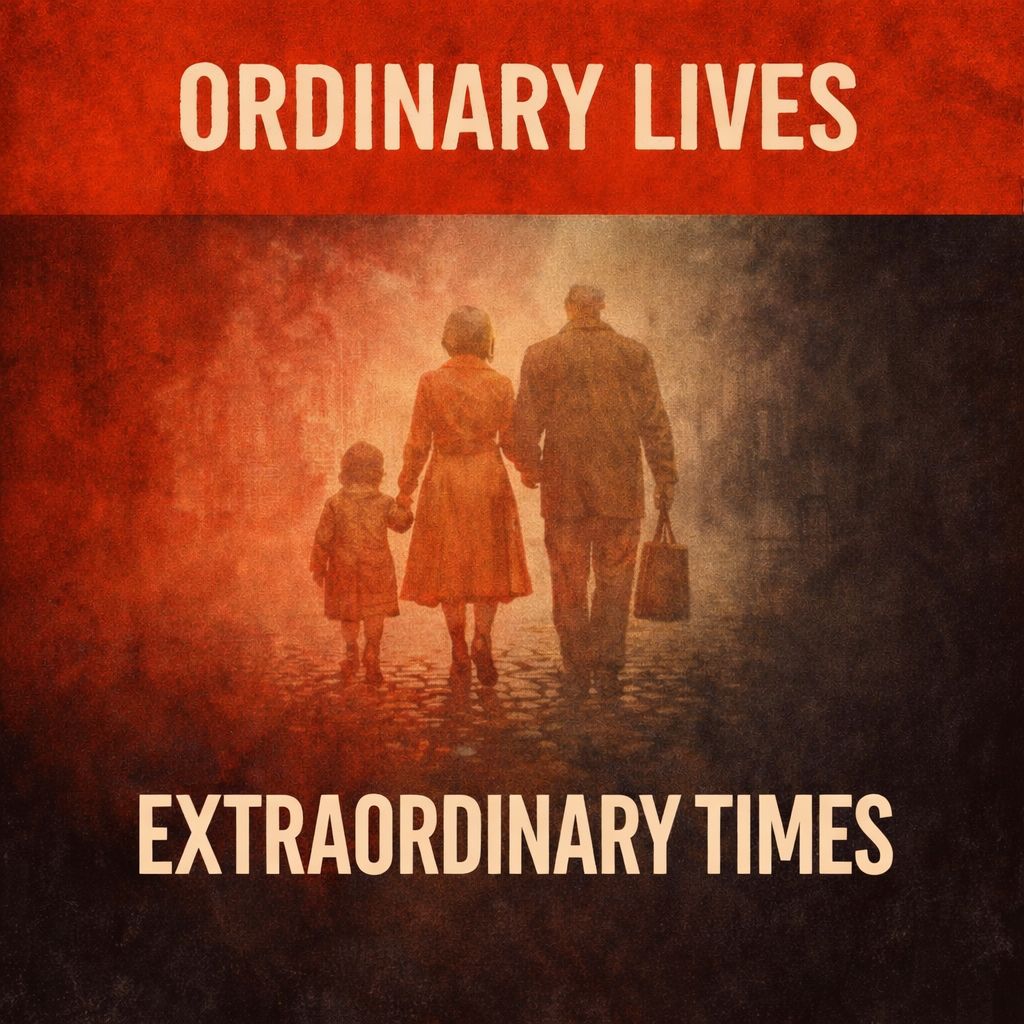
Fire in the reichstag
Greetings, everyone. Welcome or welcome back to Ordinary Lives, Extraordinary Times. Today we’re going back to the Reichstag Fire and the shockwaves it sent through Germany and eventually the world.
In our last episode we covered the Great Depression which devastated the economy as much as people’s faith in democracy. When the Nazis were appointed to the Chancellorship, many people felt months of tension finally snap!
I’d planned this to be a mini episode but decided to give it a little more love than that. The journey from Hitler’s ascension to Reich Chancellor to dictator was not a smooth one. Filled with fear, doubt, hesitation, and hope most people just tried to keep calm and carry on. Despite this…
You know those moments when you immediately realize you’re witnessing history? You don’t know exactly what comes next, but you know life won’t quite be the same afterward.
For my niece’s generation, it was the COVID lockdowns. For my generation it was 9/11. For our parents, it was the Fall of the Berlin Wall.
We remember these events because they become milestones in our lives. We measure time against them. We remember where we were, what we were doing, and how the world seemed different afterward and the days before are often memorable because of what happened later.
What we often underestimate, however, are the second and third-wave consequences. We see the event itself, but not the ripples spreading outward through history.
Unless you were in Berlin, Hitler’s appointment was like any other evening. Celebrations were organized after in other Places. Northeim’s occurred three days after the parade in Berlin.
For a majority of Germans it was the night of February 27, 1933. Germans understood that the burning of Parliament was one of those moments. It was important. It would have consequences.
What few could have imagined was that the chain of events set in motion that night would help destroy German democracy, unleash a world war, and eventually bring the soldiers of the Soviet Union to the very steps of the Reichstag as conquerors.
So hold onto your hats, because this is going to be a wild ride.
When Hitler was appointed Chancellor in January 1933, he controlled the largest political party in Parliament but did not yet control the government. He still had to deal with Social Democrats, Communists, and other annoyances before he gathered the necessary support to completely rebuild the country into his own image.
Political sabotage created a deadlock in parliamentary debates which cripple the government. Eventually, it got so bad Reich President Hindenburg dissolved it and new elections get scheduled for March 5.
So! Parliament is empty. Again. Citizens are bombarded with election slogans and political speeches. In many ways, these days looked much like those before Hitler became Chancellor. It could almost be called a false sense of security.
Even the Nazis were feeling the strain. Joseph Goebbels noted that his campaign workers and volunteers were exhausted after nearly a year of almost continuous elections. Germany had become a nation permanently on the campaign trail.
First Stop: Germany Before the Fire
Despite some minor exhaustion, the Nazis were working the election with their usual propaganda leaflets and speeches vilifying the Left and democracy, but most citizens were still wary of their rough history. That didn’t stop changes from occurring though.
Police were placed under the command of Hermann Goering, Nazi Party boss in Prussia and future head of the Luftwaffe. Thus began a brutal campaign targeting rival election demonstrations, opposition newspapers and meetings. Certain Communist and Social Democrat newspapers were banned but it was hardly more excessive than what came before.
Assaults and harassments against the Communists went unchecked. Lady Rumbold saw a trio of Brownshirts chase one down the street before finally catching up with the poor man. I hate to think what they did to him.
The Nazi Leadership expected a landslide victory now they had the full weight of the State behind them. Goering was nearly giddy when he wrote in his journal how easy it would be. Big business could hardly contain their own excitement, the new administration would QUOTE put the workers in their place. END QUOTE (Rise & Fall 190)
You know that meme of Futurama when Fry is holding the wad of cash saying, “shut up and take my money”. It was like that.
American activist Abraham Plotkin met with several colleagues. All of them were fellow Jews. Abraham wrote in his diary later:
Strange as it may seem, and it seemed strange to me, they were not concerned very much that Hitler has come [to power]…that it was bound to come…and perhaps it better that the Hitler fire run its course.
Julia Boyd. Travellers in the Third Reich
Others were not so optimistic or lucky about what hand fate dealt them. Many Opponents of the regime were already being fired from their positions; many of them tenured.
Right from the start, the new regime launched a purge of Jews from the Republic’s cultural institutions. Critics and officials attacked one conductor’s work so thoroughly he went into self-appointed exile in March 1933.
Hitler’s appointment also triggered a flood of applications to local Nazi Party offices. Yet most Germans still kept the movement at arm’s length. Some undoubtedly wanted to see what the coming election would bring before committing themselves.
The Nazis were planning a coup with massive arrests and a regime of terror. We should be prepared for the worst in the next few weeks. It made me uneasy but of course it was only a matter for the press. Overheard scraps of conversation, laughter, music, freely given smiles; this was the true reality wasn’t it?
Listener, we have the benefit of reading books and seeing a collection of these headlines and know right where all this goes. They didn’t. All of these things happened in a hundred places days or weeks apart. In between stories of a Communist being beaten up or an obscure Jewish shop being picketed you read everything you’d expect to read: sports, weather, world news. History is slow in real time.
That’s why video games don’t do things “in real time”.
Back to history! When a man tried to warn the President of the German Clothing Workers Union of the dangers the new administration faced, he was told:
[The Union President] said every one of the questions I raised has been fully discussed…Hindenburg would not tolerate any dictatorship established through sheer terror or unconstitutional means.
Travellers in the Third Reich.
Despite the increasingly tense political atmosphere, Berlin was preparing for one of its favorite traditions: Carnival. Celebrated in the days before Lent, the festival filled the streets with costumes, masks, dancing, music, and, perhaps most importantly, copious amounts of alcohol.
Sebastian Haffner, then a young law clerk in Berlin, paints the scene for us:
Carnival ball in Berlin is like a large, colorful, well-organized love raffle with winning tickets and duds. You take your chance, join up with a girl, kiss and cuddle her, and go through all the stages of a love affair in a single night. The usual end is a taxi drive at daybreak and the exchange of phone numbers…it all takes place in a wild, garish environment with the clashing noise of several dance bands in a building decorated with colored paper accompanied by as much alcohol as you can afford!”
Sebastian Haffner. Defying Hitler
We often think of our grandparents and great grandparents who grew up in this time, as fuddy duddy’s who don’t know what fun is. By what Herr Haffner says about Carnival it sounds like we’re the ones missing out. The idea of dressing up and going to a big floor to a brass jazz band while being surrounded by bright colors seems like my kind of party!
Herr Haffner. Unlike other partygoers, he found it difficult to get into the fun despite the rivers of booze and shiny, glowing, eager, smiling faces.
As Nazi hope for an overwhelming electoral victory was in doubt, rumors of an imminent Nazi coup were swirling from mouth to mouth. Just he was on the verge of what sounds suspiciously like a panic attack…
An arm pushed itself through mine from behind. It was an old acquaintance…interposed herself between me and my [unhappy] thoughts. Within an hour I found myself a partner…not just for the night but for a whole desolate period to come.
Defying Hitler
The young lady’s name was Lisl. She stood a few inches shorter than Haffner, with short black hair. He compares her to the actress Elisabeth Bergner, who was popular at the time, and says she wore the costume of a “Turkish page boy.”
I had to look this one up, Listener. From what I could find, it was a popular costume of the day. Think baggy trousers, an embroidered tunic, a sash around the waist, and either a turban or a fez, preferably in the brightest colors imaginable.
There’s something rather charming about how Herr Haffner devotes an entire page to his first meeting with this woman. I imagine the memory carried him through some of the dark days that lay ahead.
It wasn’t all fun and games, though…
A rumor spread through the party that the police hauling people away from the floor below. Most there thought it was a joke.
Then a young man dressed entirely in black pushed his way to the center of the room and announced that everyone needed to leave immediately unless they wanted to be arrested and taken to police headquarters on Alexanderplatz.
The party officially spoiled, Haffner joined the throng of others, leaving only to discover real police downstairs and asked one whether they really had to leave.
The reply was itself was odd: “You have permission to leave.”
Building on that,
(1) that was what was asked and(2) it assumed they could be detained at the whim of a police officer without any legal justification, also known as unlawful detainment and was still highly illegal.
It took Haffner a minute or two for the recollection to hit him. The man in black had been a guest all along. Minutes earlier he’d been drinking, dancing, and enjoying the Carnival like everyone else. Haffner thought the black uniform, the trademark of several far-right militias, was in poor taste. Suddenly, it didn’t seem quite out of place just highly inappropriate. Why did he go from partier to enforcer?
Those are questions for the ages, my friend. Everyone went home. The elections were a little more than a week away scheduled for March 5.
Second Stop: The Official Story
Marinus van der Lubbe, a near-blind non-German Communist, was an arsonist with a record. Only just released from jail. Witnesses claim he was overheard at a bar bragging about his past arson crimes and various arrests. Numerous witnesses claim he vowed to burn down Parliament to protest the high unemployment.
There was a lone policeman, Chief Constable Buwert, at the scene that night. Two men came to him reporting a break-in. The first, a student, stated he heard a window break and saw someone with a torch on a balcony. The second was a journalist who corroborated the story and reported he spotted 2 intruders WITH TORCHES already inside. Firing his pistol only caused the arsonists to flee deeper into the vacant building. Fearing they were armed Chief Constable Buwert retreated to call for backup.
Smoke began to escape from the dome a moment or two later followed by leaps of flames.
Minutes later the first fire engines start screaming up and our hero rushes to warn the firemen of the two arsonists still inside. (The Burning of the Reichstag. 29).
von Papen wrote later:
…We noticed a red glow through the window and heard sounds of shouting in the street. One of the servants came hurrying to me and said The Reichstag is on fire!…from the window we could see the dome of the Reichstag…every now any again a burst of flame and a swirl of smoke blurred the outline.
William Shirer, Rise and Fall of the Third Reich.
The culprit was apprehended as he ran outside a few minutes after starting the fire and was immediately ID’d as the Communist arsonist which had just gotten out of jail.
Reich Chancellor Hitler was having dinner with some ministers nearby when he received a phone call with the news. At first, it was treated as a joke until confirmed. That’s when everyone abandoned dinner and piled into cars.
Sensing there was little more he could do, Chief Constable Buwert gave his statement and left the scene. As he crossed the Republic Square, he turned for one last look. The dome of the Reichstag was now glowing with fire. (The Burning of the Reichstag 30)
Then the Chancellor and his entourage pulled up in a small convoy. He is briefed and then goes into a tyrade declaring the destruction the signal for a Communist revolution.
Rudolf Diels, head of the Prussian political police, was put in charge. He spoke to the culprit at the scene of the crime. The conversation did not leave an impression of a grand conspiracy.
His upper body was naked, sweating, and smeared with dirt. He sat in front of them, breathing heavily…I listened to his confused stories. In my opinion he was a madman. I reported it to Hitler but he mocked my childish credulity.”
Richard J Evans. The Coming of the Third Reich
Rantings of the criminally insane aside:
Herr Heffner had his pulse on the political worries of his friends and neighbors. The Reds had talked a big game for years and backed it up with some brawls and rebellions in the past. Why should today be different?
A Communist attack is what we expected. They were determined people with fierce expressions. They raised fists in salute, had weapons. They boasted continually about the strength of their organization and probably learned how to do ‘these things’ in Russia.
Defying Hitler
He didn’t buy the official version of events but saw sound reasoning on why so many believed it: the Communists were always boasting about strong numbers and revolution. What bothered him was the explanation QUOTE settled the matter END QUOTE.
Despite the Red propaganda of a far-reaching movement with connections everywhere just waiting for the right time to jump to revolution they were a minority issue. What happened after the fire proves how impotent the KDP was despite its assumed popularity.
The day after, officials issued a public statement it discovered “documents” proving:
Government buildings and…essential plants were to be burned down. Women and children were to be [used as human shields]. The Fire was to be the signal for a civil war.
Shirer. Rise and Fall of the Third Reich
Officials promised to release the full texts of these ‘discovered documents’ but it was another one of the Nazi lies. These documents, if such a treasure trove ever existed, were never released.
At first glance, the case seemed open and shut. A suspect had been caught at the scene. He confessed. The government announced it had solved the crime. History, however, has a habit of asking awkward questions.
- Third Stop: Smoke of Doubt
The arsonist, van der Lubbe, was described by reliable historians as ‘intellectually limited’. I’m not going to make any bones about it; he likely had a mild to high-functioning cognitive disability. More on that down the line.
He was also partially blind. He was working in the dark with a flashlight. This was an alien environment to him. Then, using his own shirt, starts a fire and ran it around the room torching various things as he went. Ten minutes later it’s sending flames up the 250-foot chamber.
I’d imagine the inside was 50 year old carpet, polished wood desks and cushioned chairs. Undoubtedly the most flammable things in the place were the giant curtains. Can someone let me know how flammable polished fixtures are.
Anyway…
He admitted to starting the fire. He denied using chemical accelerants. He denied having accomplices. He insisted he acted alone and took it with pride all the way to the guillotine. You heard right. I said guillotine.
But his confession might be false.
In an out of psychiatric care facilities his entire adult life, the man had a tendency to claim credit for arsons and strikes even when he was innocent (The Burning of the Reichstag 51).
But where does the lying come in? Could he have lied about using gasoline? Did he lie about acting alone?
But let’s put that away for now. Let’s say for the sake of argument van der Lubbe was telling the truth.
How does a building that size burst into flames at the drop of a hat?
Charles River Editors in The Burning of the Reichstag suggest it might be something fire-fighters call a Flashover. That’s the moment when a fire becomes so hot that nearly every combustible object in a room ignites near simultaneously. Instead of flames spreading gradually from one item to another as you’d expect, the entire room erupts into fire within seconds. (Burning of the Reichstag 31)
IF that is what occurred, you need accelerants.
But wait! Van der Lubbe didn’t use any of the stuff! Yes, he did say that. But evidence suggests they were. The thing about using chemicals to start fire is it leaves signs behind. It burns hotter than what’s around it so it will have a different burn path.
Did they find anything like that? Yes they did!
Charles River Editors goes on. In the trial that followed, a firefighter was questioned about what he saw while combating the blaze:
The trail ran from one door to the other. A few stretches of carpet along the trail were completely burned out. [It’s] believed it had been gasoline. [Another] testified to seeing a fire on a runner that led from the lobby to the plenary chamber and described another fire in a line against the wall which he first mistook for floor lighting.
Burning of the Reichstag
Does all that mean van der Lubbe was lying? Maybe.
Or he had help. Though he didn’t know it. More on that later!
Only a few hours after the fire Lady Rumbold spoke with friends at the British Embassy. She remembered even at that early hour there was abundant suspicion the Nazis started the fire to discredit the Communists before the next election. (Travellers in the Third Reich 109)
The Communists as a collective had nothing to gain by burning down the joint. Process of elimination leads to the Nazis themselves.
IF you call that a leap just take this into account: in the many perfectly good hours after the fire there was not a single Communist uprising anywhere in Germany.
Also, if the Fire was supposed to be the signal to start a national uprising, why were so many of the enemy leadership asleep in their beds when the first wave of arrests began?
I’m no general but I know uprisings needs certain conditions to be considered such. The first rule is: don’t be asleep.
I joke. Partially. That is a really good rule but one that shouldn’t need saying. But what one does need for a coup are short: men, a call to action, and weapons. The communists had all of these things. But in this instance, circumstance dictates a final condition be met: fighters at the starting line.
Why am I adding this last one? Because governments aren’t stormed by ghosts. Men gather at pre-determined places, receive orders, arm themselves, and then attack.
If the Reichstag was a signal for a grand revolt, the logical moment to strike was while it burned. Not hours later after police and army are put on alert.
Fourth Stop: What Might Have Happened
In 1940, Hermann Goering boasted to partygoers he planned the operation and made a list of people to be arrested immediately following. The part about the arrest lists is true.
It is his claim a members of his personal guard used the tunnel running from the Reich President’s Palace which connected it to the Reichstag. They doused the main chamber in gasoline and other chemicals before departing to wait for their Patsey to unwittingly finish the job for them. There is no way so substantiate or disprove this claim.
There is another possibility worth considering…and this is pure speculation from here until our next stop.
Suppose van der Lubbe really did intend to burn the Reichstag by himself. We know he had tried to set other buildings on fire before. We know he talked openly about wanting to make a dramatic political statement. That much isn’t in dispute.
But what if someone overheard him?
They wouldn’t have needed to reveal themselves as Nazis. They could have posed as sympathetic revolutionaries, offered to help, and promised access to the building. Van der Lubbe still broke a window after finding the doors locked, suggesting whatever plan might have existed did not unfold exactly as expected. If others had entered beforehand, spread gasoline or other accelerants through the chamber, and slipped away before he arrived, van der Lubbe might genuinely have believed he was acting alone.
That would also explain his astonishment at how quickly the fire spread. Within minutes the debating chamber was engulfed in flames.
After his arrest, he insisted until the end that he alone deserved credit. That was not unusual. Political extremists, gangsters, and assassins of the era often claimed sole responsibility for dramatic acts, even when others had quietly helped behind the scenes.
Fifth Stop: The Hammer Falls
Police, both legit AND emergency Nazi deputies assembled by the truckload and swung into action. By midnight, the first unlucky communists were having their homes raided and being arrested. Initial figures vary between historian to historian.
Regardless of truth, the following day President Hindenburg signed the Decree of the Reichs President for the Protection of the People and State. It was better known as the Reichstag Fire Decree.
What did this do?
- Freedom of Expression
- Freedom of the Press
- Freedom of Assembly
All these disappeared. And worse, it allowed police to arrest and detain without oversight by the courts indefinitely. (Evans. Coming of the Third Reich 331)
A participating Brownshirt said
We were prepared. We knew the intentions of our enemies. I had put together a small squad from the most daring of the daring! We lay in wait night after night…then the beacon in Berlin. Finally the relief of the order: Go to it!
Richard J Evans. The Coming of the Third Reich.
It wasn’t just Communists which found themselves on the receiving end of Nazi wrath. Pacifist publisher von Ossietzky and attorney Hans Litten which humiliated the now-Chancellor in open court years prior found themselves being picked up.
Our good friend Herr Haffner was at a party the night of the fire. At midnight they turned off the radio and were unaware what happened until reading the newspaper the next morning.
According to Shirer, some four thousand citizens, both communist and social democrat and everything else, were arrested including members of Parliament which were supposed to be immune from arrest.
Within hours, the police arrest sheets at Alexanderplatz prison read like a who’s who of writers, lawyers, and politicians who’d made enemies of the Nazis. Everyone knows everyone else and everytime someone new is dragged in by the police there are greetings all around.
Wachsmann. KL: A History of the Nazi Concentration Camps. 29
An atmosphere of paranoia and panic spread to every corner of the country. Truckloads of storm troopers and police roared through towns and cities, breaking into homes and rounding up so-called enemies of the state. The speed and coordination of the arrests made it clear this was not a spontaneous reaction to the fire, but the execution of plans already waiting in the drawer.
180-miles from Berlin, two Englishmen were enjoying a leisurely breakfast at a rural Inn unaware of the calamity raving everywhere until the Innkeeper rushed in with the news.
“Everything is lost in Berlin. It’s burning everywhere! It was the communists! They’re all under lock and key by now! There are roadblocks. You’re English so you can probably make it. But if you can’t come back to us – we have soft beds and warm food!”
Travellers in the Third Reich. 110
Arrests continued for days. Homes are raided. Dishes and furniture are broken. Desks are broken into. Neighbors watch as fathers and mothers are taken away at all hours.
Men and women were seized at work by police or vigilante bands, often shoved, punched, or dragged into waiting cars.
And if you expected a police station, you might instead end up in a warehouse basement or back room, at the mercy of men who could beat and hold you as long as they pleased, with no lawyer able to help. Most are “released from custody” eventually thankful to have their lives intact. An unfortunate few too dangerous to be left alive, to use the euphemism, are shot while trying to escape.
Final Thoughts
You may ask what happened after all this settled down? There was a trial. Five people indicted. There were paraded in front of a kangaroo court where they embarrassed the hell out of the prosecution. Not that it mattered in the long run.
Today, despite a small mountain of literature, we still have no answer to what really happened that night.
Van der Lubbe received a posthumous pardon from the German Federal Republic in 2008. This pardon did not find him innocent; it said the verdict was nullified because it was passed by a dictatorship.
Ian Kershaw reportedly said about the man and his scheme:
“He was… a solitary individual, unconnected with any political groups, but possessed of a strong sense of injustice at the misery of the working class at the hands of the capitalist system. In particular, he was determined to make a lone and spectacular act of defiant protest at the Government… in order to galvanize the working class into struggle against their repression.”
[https://spartacus-educational.com/GERlubbe.htm]
But whether or not the Nazis were behind it is an interesting question. They’d pull false-flag operations frequently in the years to come but this one has too many variables and what-if’s to keep a historian busy for a while.
Thank you for listening to Ordinary Lives, Extraordinary Times. If you like that episode, please hit like and subscribe. It really helps in the algorithm. You can find a script for this and other episodes on the website: http://www.ordinarylivesextraordinarytimes.blog.
Until next time. Long live the Republic!
“Ordinary Lives, Extraordinary Times”
(c) Jay Daniels. All rights reserved.

