Culture in the Third Reich
Nazi culture didn’t emerge out of nowhere. It defined itself as the antidote to Weimar. Where the republic had been chaotic and experimental, the new regime promised order, unity, and moral clarity. In practice, that meant something far more rigid: culture was no longer a space for exploration but a tool of the state; art, music, film, even leisure. Everything was expected to serve the ideology of the regime and reinforce a single, approved vision of German life.
Reorganizing Germany
It branded itself as the continuation of a great German nation birthed in pre-history. Arminius, Charlemagne, Frederick the Great, among other notable figures were hailed as saviors and guardians of the nation from enemy cultures. The Nazis were forging a German ‘third empire’ as the alleged heirs of these protectors and saviors.
At the center of that effort stood Ministry of Public Enlightenment and Propaganda under Joseph Goebbels. This wasn’t just censorship. It was total cultural management. Artists, writers, musicians, and filmmakers had to join state-controlled chambers or they simply couldn’t work. The goal wasn’t subtle persuasion; it was saturation. Every poster, radio broadcast, and film was meant to shape how Germans thought, felt, and even imagined reality.
When the Northeim police prefect was about to leave his office for the evening, a local Nazi barged into his office.
“Taking off his own silver swastika pin, he threw it on my desk and told me, ‘Put that on. If you don’t, you won’t be Prefect tomorrow.’ Thus, I joined the Nazi Party.”
The Nazi Seizure of Power
What is not often remembered is the plans and money the Nazis used to provide relief were already approved and in motion by the time they came to power. In fact, they spent their tenure in the Reichstag blocking or obstructing various other relief legislations before inheriting and implementing the solutions they previous blocked.
Most of the foreign correspondents in Berlin liked to congregate at this little eatery called the Taverne. A visiting British diplomat paid a visit during a trip to the city and remembered the establishment well but not fondly:
Several of them gathered there each night to talk about the latest atrocities. I thought the conspiratorial atmosphere absurd until I realized they were actually in danger not least from trumped up charges of espionage!
Boyd, Julia. Travellers in the Third Reich
Economically and socially, the regime projected stability and recovery, especially compared to Weimar’s crises. Public works, rearmament, and declining unemployment created a sense of forward momentum. For many ordinary Germans, daily life in the mid-1930s felt more predictable, even optimistic. That stability, however, was tightly interwoven with repression, militarization, and preparation for war. Wages never returned to pre-1929 rates. Labor-unions were replaced with a regime-backed union which favored the business owners. Media was censored.
A Command Economy
A pact between big business and the Nazi dictatorship helped seal Germany’s fate in 1933. In return for crushing the labor unions and rolling back worker protections under various “emergency decrees”, the country’s biggest corporations pledged to publicly support the regime (despite in some cases they fought against the Nazis rise to power).
Manufacturing was switched from a priority on consumer goods to armaments by the mid-1930s. National price-fixing cushioned the cost to the average German during times of scarcity.
“Most Germans alive today have lived through three periods of malnutrition: first during the Great War, then during the peak of the inflation in 1923, and now, for the third time, under the slogan of ‘guns before butter.’”
Sebastian Haffner. Defying Hitler
The Nazis formed a national labor union called the German Labor Front (DAF) which shaped your day during work hours and off. Enrollment was expected. It stripped any bargaining or leverage power from the worker and enforced government expectations. To compensate for the loss of rights, the Party gave them mandatory clean and safe working environments, factory canteens, and wash facilities.
Workers lost the ability to switch jobs at will, too. The expectation was to serve the state and leadership toward a better future; switching jobs would interfere with efficiency and workplace morale. Bosses and security police were constantly on the lookout for absenteeism and work-shirkers. Poor health might be excused but dead-weight on the factory floor (or any workplace) would be dealt with harshly. Punishments would vary from job loss to professional blacklisting.
“The German community, the rest of the 70 million Germans, apart from the million or so who operated the whole machinery of Nazism, had nothing to do except NOT interfere.“
Meyer, Milton. They Thought They Were Free, 57
Film became one of the regime’s most powerful tools. Directors like Leni Riefenstahl created visually stunning works such as Triumph of the Will, which presented the Nazi movement as almost mythic—orderly masses, heroic leadership, a nation reborn. Even entertainment films, comedies, and romances were carefully curated to reinforce acceptable values. The audience wasn’t just watching stories. They were being gently trained in what normal was supposed to look like.
Music and art followed the same pattern of control. The Nazis promoted classical composers like Wagner as embodiments of German greatness while condemning modernist movements as “degenerate.” Jazz, so central to Weimar nightlife, was banned after being labeled foreign and corrupting.
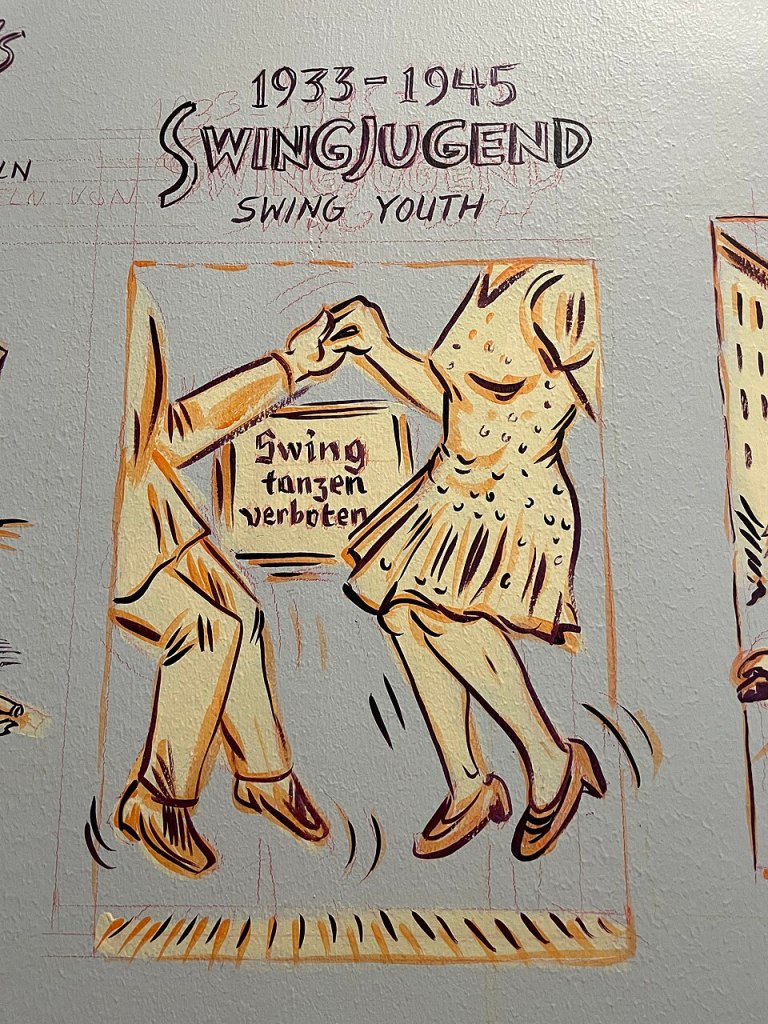
This gave rise to an unusual youthful rebellion we know as “swing kids” where both boys and girls would intermingle in basements, homes, or pre-designated establishments to listen and dance. Boys would often wear their hair slicked back which was not approved by the State. Girls would frequently adopt a coiffured style with lipsticks and the latest fashions from the West. Not all of them were anti-Nazi. Many were just enjoying youthful rebellion.
Exhibitions like the infamous Degenerate Art show mocked modern artists while elevating state-approved works: idealized farmers, strong soldiers, serene mothers. It was art stripped of ambiguity: clear, direct, and ideologically obedient.
Germans did not always conform to how the Nazis wished they would. The German Art Exhibition was opened with great fanfare in 1937 in the heart of Munich. It was filled with pieces approved by Hitler personally. The Degenerate Art Exhibition opened the following day in the hopes of fueling public disgust quickly became one of the most successful in Germany.
To enforce its will on each street corner, loyal Party members could be given the job of “Block Warden” of their neighborhood. It was a position given specifically to men who would be tasked with informing any political or criminal infraction to the local police or Gestapo.
Assimilation & Segregation
The National Socialists made their anti-Semitism public from the very beginning. At first, their violent rhetoric turned many people away. But by the early 1930s the Party had toned down their anti-Semitism in certain regards but it always remained a cornerstone of their ideology.
Jews found the regime increasingly hostile from its very ascension.
Viktor Klemperer, who converted from Judaism to Protestant [that’s the only information I’m given via the Source] was declared a racial Jew because of his ancestry and thus subject to the anti-Semitic laws. He was under no illusions what the Nazis would bring. He wrote in his diary:
“I am almost used to the condition of being without rights. I am simply not German and Aryan but a Jew and must be grateful if I’m allowed to stay alive.”
Victor Klemperer, I Will Bear Witness
Other persecuted groups, like the Communists and homosexuals, were forced to disavow their former beliefs and assimilate into the new society. Those who were among those now persecuted now distanced themselves from old friends.
Some homosexual men and women intermarried to save themselves from arrest later on. Others returned to their ‘everyday lives’ to carry on a discreet rendezvous when an opportunity arose.
The Next Generation
The Nazis wanted to indoctrinate every German into the new way of thinking. It began inside the classroom. Each subject was changed to conform to the new world-view. Instructors had to be members of a Nazi educator organization. Compliance with the new curriculum was expected; or bad things would happen to the teacher. Schools taught their students Germany was surrounded by enemies trying to cheat her.
It was an us against them mentality. A future, final, conflict to secure the country’s place in Europe was coming. To ensure the country was ready for the coming war, the Nazi Party needed soldiers. They planned to mold them from Germany’s youth.
At ten years old, boys entered the German Youth (Deutsches Jungvolk). Much like the better-known Hitler Youth they wore uniforms and participated in hiking and camp making with their older brothers. Lessons focused on athletics, racial and ideological lessons, and obedience training. Girls inducted into Junior Girls (Jungmadel) also learned how to obey while on hiking trips and camping. Lectures and practice taught early domestic skills in cleaning and helping raise younger siblings.
At fourteen, both advanced into the next state-sponsored organization. For boys, it was called the Hitler Youth (Hitlerjugend). Girls continued into the League of German Girls (Bund Deutscher Madel), BDM. Girls endured training in childbirth and raising, first aid, and cooking for a large family. Boys were trained in discipline and physical fitness. They were also given shovels keep clean and drill with while learning camp making skills and hand-to-hand fighting and small unit combat tactics from older teenage instructors. The purpose was to transpose what they learned as youths into the Army later as adults.
Both the Hitler Youth and League of German Girls participated in mandatory outings and meetings with their peers. Camps were set up in the countryside to teach them the necessary skills to survive in the Third Reich. Incidents of teen pregnancy occurred but would be protected by the regime.
Technical schools were established by the regime to enhance the skills of those with talents in the fields of radio, sports, mechanics, and the like. Once both genders came of age, they would be sent to perform manual labor in the countryside helping farmers bring in the harvests, dig ditches, and build barns.
It was a parallel education system, shaping identity, loyalty, and worldview long before adulthood. From birth until adulthood, children were surrounded by Nazi ideology. They were taught to serve the State and the Party from the age they learned to think.
Home & Leisure
Gender roles were sharply defined and relentlessly promoted to ensure victory in the coming battle. Women were encouraged, through policy and propaganda, to embrace “Kinder, Kuche, Kirche” (children, kitchen, church). Professional opportunities narrowed, especially for married women, while incentives were offered for large families. Men, meanwhile, were cast as warriors and providers. Compared to Weimar’s fluid and experimental gender culture, Nazi society drew hard lines and enforced them with both social pressure and state policy.
The regime also worked to reshape everyday life through programs like Strength Through Joy. This organization offered subsidized vacations, concerts, and recreational activities, presenting the regime as both provider and benefactor. The idea was to bind citizens emotionally to the state, not just through fear or ideology, but through positive experiences. Even leisure became political, reinforcing the sense of belonging to a unified national community, or Volksgemeinschaft.
Of course, that “community” was built on exclusion. Those beneficial to the Nazis long-term plans would be kept in German society. Those deemed harmful: Jews, intellectuals, Masons, liberals (Social Democrats, Communists, Centrists, etc.), Roma, mentally-disabled, physically handicapped, and the generally disliked, were systematically removed from cultural life long before the full horrors of the Holocaust unfolded. The same applied to political dissidents, LGBTQ individuals, and anyone deemed “undesirable”. Liberal institutions like Institute for Sexual Science were destroyed, books were burned, and entire cultural currents were erased. Nazi culture didn’t just promote certain values, it actively eliminated alternatives.
Faith & Hero Worship
Religion occupied a complicated space. The regime tried to co-opt Christianity into a more nationalist, racially aligned form while also promoting a kind of cult of personality replacing Jesus’ Jewish roots to ‘Aryan’. They created various councils and associations to ensure churches across Germany conformed to the new principles. In certain instances, Adolf Hitler was promoted above Jesus as the ‘Savior of Germany’. Loyalty to the state, and to Hitler, was meant to supersede all other allegiances. Spiritual life, like everything else, was expected to align with the regime’s goals.
“Hitler stressed the role Christianity would play in the National Socialist state while promoting ideology which was in direct contradiction of Church doctrine.“
Roland, Paul. Life in the Third Reich, 30
The Catholic Church did not like the harassment and arrests by Nazi officials and protested their treatment each chance they received. The Reichskonkordat signed in 1933, granted the Church protection if they remained out of politics. The Papacy agreed. It is unlikely this measure would have protected the Church for long and served as a temporary inconvenience to the regime.
The regime began transforming average Germans into supporters by harnessing nationalism and revering old German folk heroes. Parades venerating medieval culture, Teutonic brotherhood, and pan-German heritage were a fixture for years immediately after the revolution. The Nazis rewrote history to suit its own ends toward a new empire.
Final Thoughts
In the end, Nazi culture was about control: of thought, identity, and possibility. Where Weimar had been a cacophony of voices, Nazi Germany enforced a single narrative. It offered belonging, purpose, and order, but only within narrow, rigid boundaries. Everything outside those boundaries was silenced, removed, or destroyed. And that’s the grim irony: in trying to eliminate the chaos of Weimar, the regime created a system so tightly wound that it could only sustain itself through expansion, conflict, and ultimately catastrophe.
“Ordinary Lives, Extraordinary Times”
(c) Jay Daniels. All rights reserved.

