
The Treaty of Brest-Litovsk was signed on March 3, 1918, between the new Bolshevik government of Russia and the Central Powers led by Germany. Russia had already collapsed under the strain of the First World War. The February and October revolutions in 1917 shattered the old imperial government and brought the Bolsheviks to power with a blunt promise: peace, land, and bread.
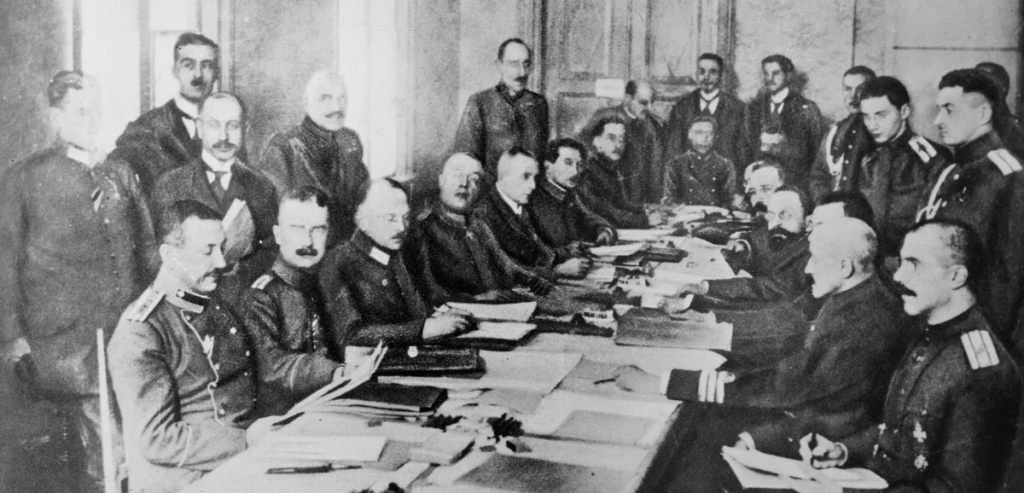
Negotiations convened in the town of Brest-Litovsk (today Brest, Belarus). The Germans came to the table in a position of overwhelming strength. Russians tried to stall, hoping the revolution would spread across Europe and rescue them from humiliating concessions.
The Revolution is Russian – Not European
Stalling failed. There was no mass call for a worker’s revolution in Imperial Germany.
The German army resumed its advance in February 1918. With German troops approaching deeper into the former Russian Empire, the Bolsheviks capitulated. Lenin, head of the Bolshevik government, knew the Russian army was disintegrating and the country was sliding toward civil war, so he accepted harsh peace terms simply to get Russia out of the conflict.
A New Empire
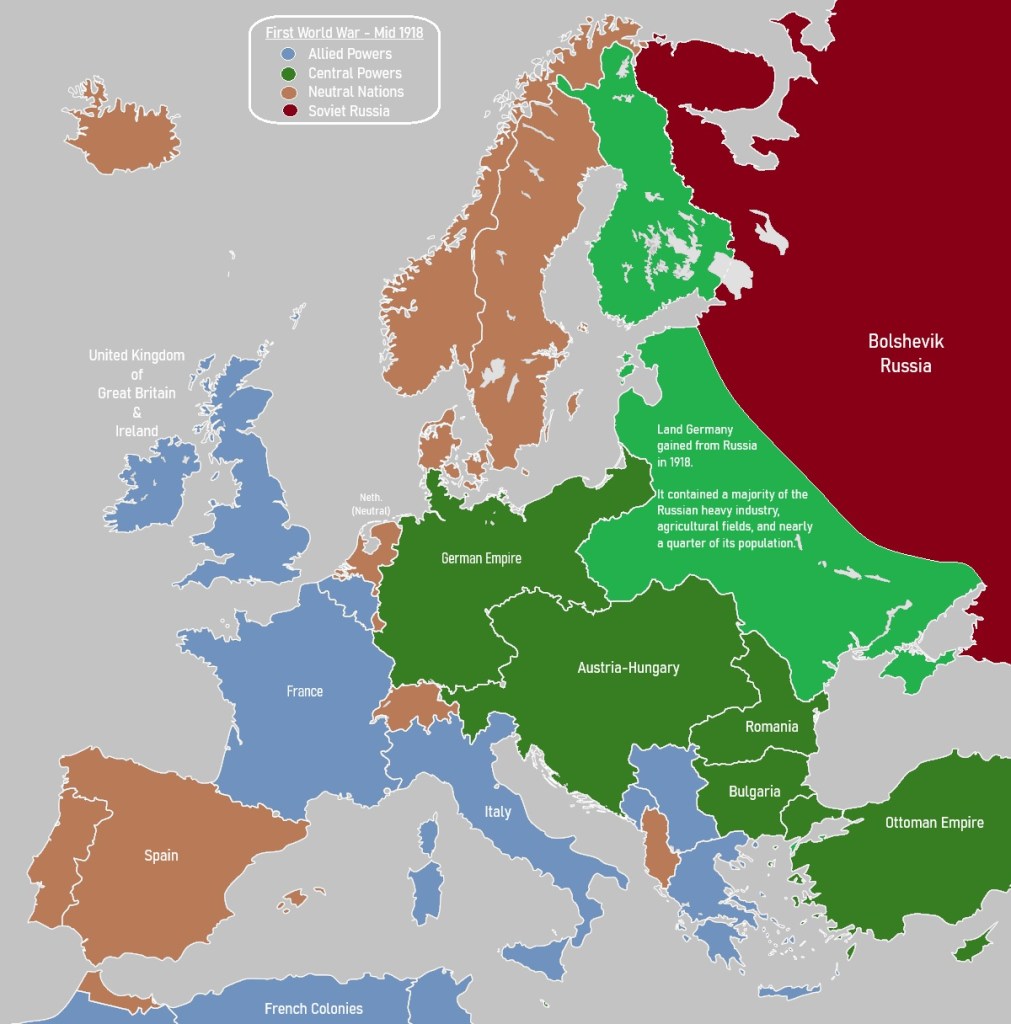
The treaty imposed staggering losses on Russia. It surrendered Finland, the Baltic states, Poland, Ukraine, and parts of the Caucasus. These territories contained roughly one-quarter of the former Russian empire’s total population, much of its industry, and enormous agricultural resources. On paper, Germany suddenly dominated a vast eastern zone stretching from the Baltic to the Black Sea. The agreement essentially dismantled Russia as a major continental power, at least for the time being.
For Germany, Brest-Litovsk looked like the payoff for years of grinding war. German planners had long dreamed of a Mitteleuropa, a German-dominated economic sphere in eastern Europe. And its agricultural potential promised relief from the Allied blockade which had been strangling the German economy. In Berlin the treaty was trumpeted as proof that victory was still possible. The high command believed that with Russia defeated they could transfer large numbers of troops to the Western Front and deliver a final knockout blow to France and Britain before American forces arrived in overwhelming numbers.
An Empire Stolen
When Germany collapsed in November 1918, Brest-Litovsk evaporated overnight. The victorious Allies forced Germany to renounce the treaty, restoring the eastern territories to new or revived states such as Poland and the Baltic republics. What had looked like a complete victory only months earlier vanished like smoke. German troops were forced to withdraw from lands they had just conquered, and the economic hopes attached to those territories disappeared with them.
The reaction in Germany was bitter and psychologically important. Many Germans had believed Brest-Litovsk proved that the nation was winning the war. When the armistice suddenly stripped those gains away, it felt like a robbery rather than a defeat on the battlefield. That perception helped fuel the later “stab-in-the-back” myth—the idea that Germany had not truly been beaten militarily but betrayed by internal enemies and politicians.
 Ordinary Lives, Extraordinary Times