
Where It All Began
The ideological soil from which the Nazi Party grew had been forming in Germany for decades before the party itself appeared. In the late nineteenth century a mixture of aggressive nationalism, racial theory, and romantic myths about the German people began circulating in intellectual circles and nationalist clubs. Society thinkers promoted the notion that Germans were part of a superior “Aryan” civilization threatened by modern liberalism.
After Germany’s defeat in World War I these ideas fused with rage and humiliation. Many Germans believed the army had not truly been defeated but betrayed by politicians and revolutionaries at home, a conspiracy myth later called the “stab-in-the-back.” This wounded nationalism created fertile ground for movements promising restoration, revenge, and national rebirth.
A Movement From the Ashes
Out of this chaos emerged the small Munich group that would become the Nazi Party. In 1919 the German Worker’s’Party, soon to be renamed the Nazi Party, attracted a young veteran named Adolf Hitler, who quickly became its dominant speaker.
The Nazi Party mixed extreme nationalism, antisemitism, and anti-communism with populist rhetoric aimed at workers and the lower middle class. Its 1920 program promised to tear up the Treaty of Versailles, unite all Germans into a single state, exclude Jews from citizenship, and create a strong authoritarian government that would defend the nation from socialism and liberal democracy alike.
Attempted Coup D’état
The early Nazi movement was loud and frequently violent. Its paramilitary wing, the Sturmabteilung, fought communists and socialists in the streets. Hitler attempted to seize power outright during the Beer Hall Putsch, hoping to imitate Mussolini’s March on Rome. It collapsed within hours, but the trial turned Hitler into a national figure. While imprisoned he wrote Mein Kampf, outlining his worldview: racial struggle, expansion eastward for “living space,” and the destruction of Marxism and parliamentary democracy.
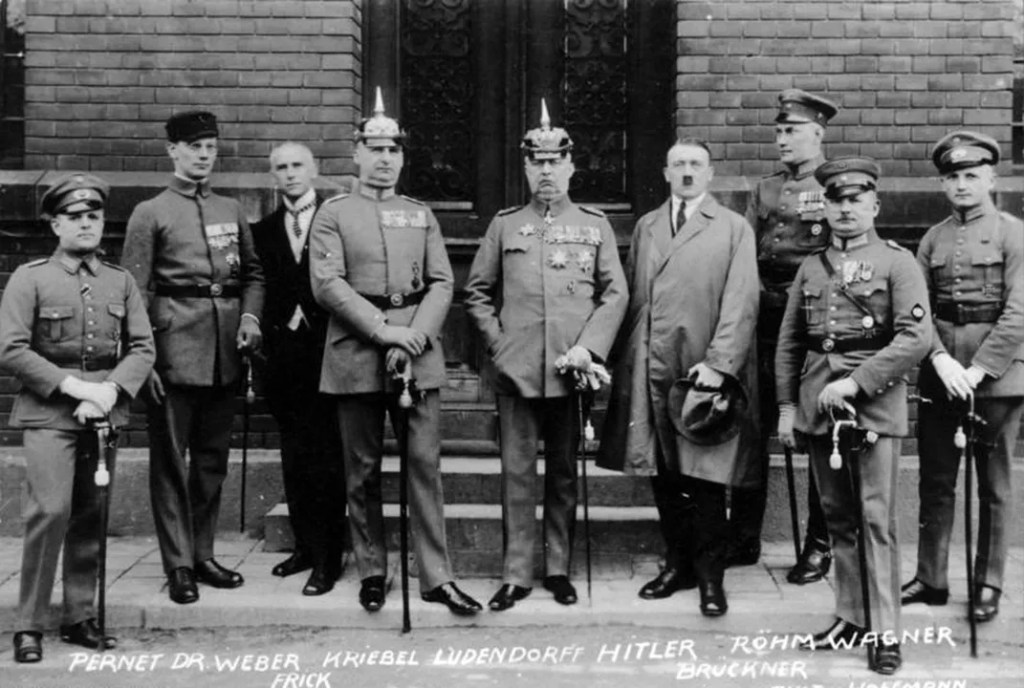
The Putsch made front page news in the papers throughout Germany. Its party membership was a celebrity list of Great War veterans and right-wing thinkers. The was banned for two years from several federal states but could operate freely in Bavaria. This is a portrait of the Beer Hall Defendants after court.
Becoming Politicians
After the failed coup, the Nazis changed tactics. Instead of trying to overthrow the state immediately, they rebuilt the party as a mass political organization. Throughout the late 1920s and early 1930s they exploited economic catastrophe, especially the Great Depression, presenting themselves as the only force capable of restoring order. Nazi propaganda promised national unity, jobs, and the defeat of both communism and the political paralysis of the Weimar Republic. Electoral support surged, and by 1932 the party had become the largest in the Reichstag.
Germany’s conservative elite believed they could harness the Nazis rather than be destroyed by them. After months of political deadlock, President Paul von Hindenburg reluctantly appointed Hitler chancellor on January 30, 1933, forming a coalition government with nationalist conservatives. Many of these politicians thought Hitler’s popularity could stabilize Germany while they controlled him from behind the scenes.
Dismantling a Republic
History, with its usual sense of dark irony, had other plans. Within months the Nazis dismantled the democratic system that had allowed them to rise in the first place. They explained it all away in various quotations by newspaper journalists and later radio speeches saying Germans never wanted democracy in the first place.
 Ordinary Lives, Extraordinary Times