The Entartete Kunst Exhibition opened in Munich in July 1937 as a centerpiece of the Nazi regime’s cultural campaign. Organized under Adolf Hitler and Joseph Goebbels, the exhibit aimed to publicly shame modern art and the people who made it. Rather than a dignified gallery, it was staged like a circus of accusations. Over 600 confiscated works crammed into tight rooms, hung crookedly, paired with mocking slogans, and labeled with inflated purchase prices to suggest corruption and decadence.
Some of the most important figures in early 20th-century European art were fetured: Wassily Kandinsky, Paul Klee, Ernst Ludwig Kirchner, Max Beckmann, and Otto Dix, and many others. Many were already forced into exile. The Nazis deliberately selected works that would look strange, unsettling, or provocative to a general audience—anything that could be framed as evidence of cultural decline.
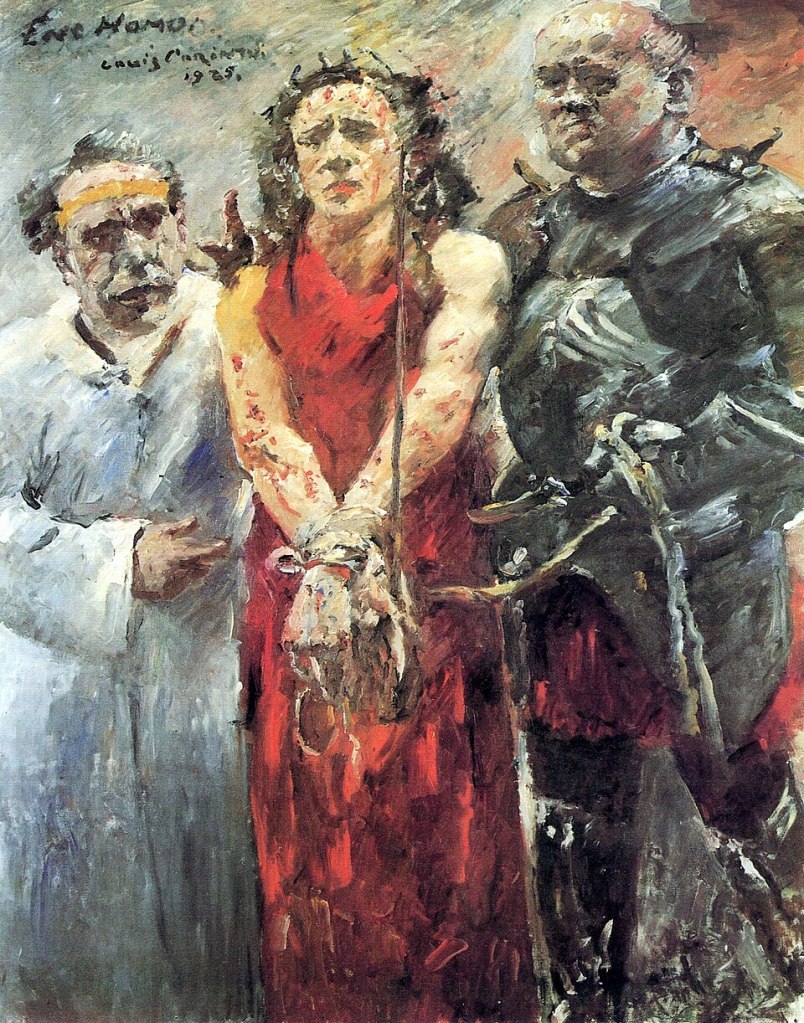
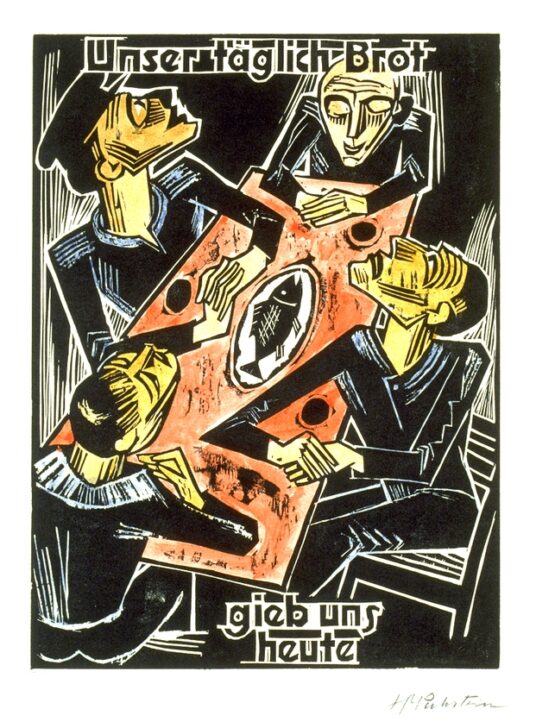
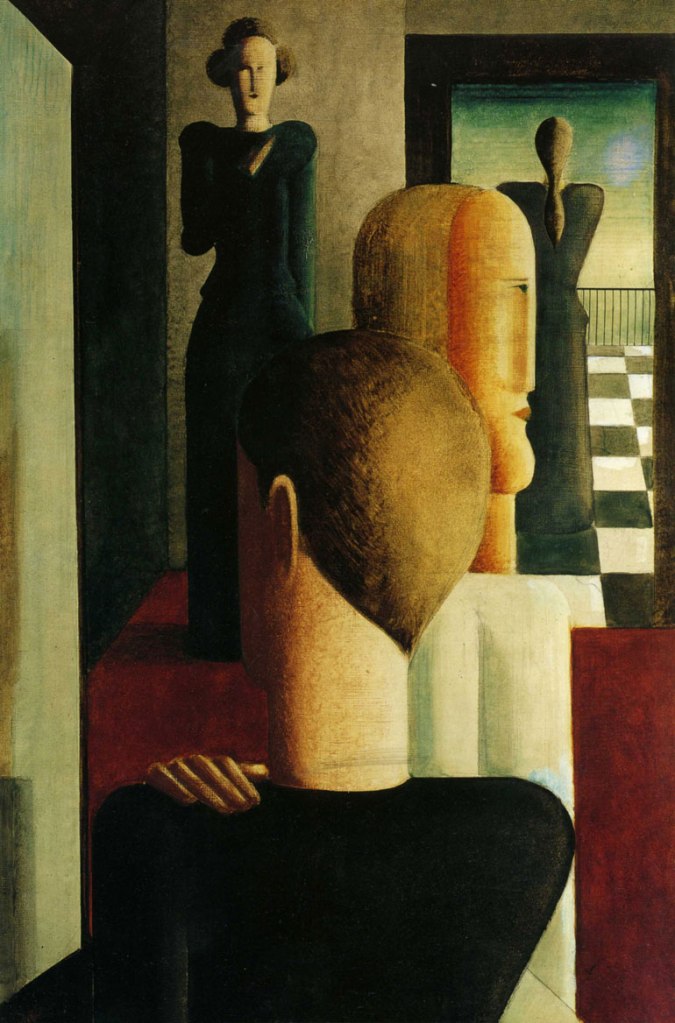
Artwork Credits (Left to Right)
- Ecce homo, Lovis Corinth, 1925, wikimedia commons, PD-US, Source Link
- Vater Unser, Max Pechstein, 1921, wikimedia commons, PD-US, Source Link
- Vier Figuren im Raum, Oskar Schlemmer, 1925 wikimedia, PD-US, Source Link
The styles on display reflected the full range of modernism the Nazis despised: Expressionism with its distorted figures and emotional intensity; abstraction, which abandoned recognizable reality; Dadaism’s chaos and anti-logic; and elements of Surrealism. To the regime, these styles represented a rejection of order, beauty, and tradition. Where classical art emphasized harmony and ideal forms, modern art embraced fragmentation, ambiguity, and psychological tension—qualities the Nazis associated with instability and, in their ideology, with political and racial “degeneracy.”
The label, “degenerate”, was ideological. The regime tied modern art to everything it feared or hated: Bolshevism, liberalism, urban decadence, and what they framed as “non-German” influences, often explicitly targeting Jewish artists. In their worldview, art was supposed to reflect a healthy, unified Volk. Anything that suggested anxiety, fragmentation, or critique of society was treated as a threat. So the exhibit functioned less as art criticism and more as a political indictment disguised as a gallery.
Despite its intent, the exhibit drew enormous crowds, ultimately attracting millions as it toured. It even edged out attendance at the official Great German Art Exhibition nearby. The reasons weren’t heroic so much as human: curiosity, shock value, and the simple fact that the condemned art was more visually appealing than the carefully sanitized state-approved works. Some came to laugh, as instructed. Others lingered longer than expected. They came in droves to see what they loved, hated, or never considered during their lives under the Republic.
 Ordinary Lives, Extraordinary Times